

92% of Sudowrite users say they finish manuscripts faster. That's a bold stat from a tool that charges $10 to $59 per month, and it raises an obvious question: is it actually that good, or just clever marketing from a company that knows fiction writers are desperate for anything that makes the blank page less painful?
We did thorough research for this review. We analyzed every plan and pricing tier, tested the platform's core features including the proprietary Muse model, went through dozens of real user testimonials from community forums and review sites, and compared Sudowrite against every major alternative. This article covers everything we found, so you can decide whether it belongs in your writing toolkit.
Try Sudowrite For FreeWhat is Sudowrite and why do fiction writers love it?
Sudowrite is an AI writing assistant built exclusively for fiction. Not blog posts, not marketing emails, not code. Just stories. It helps novelists, screenwriters, and creative writers brainstorm ideas, draft scenes, develop characters, and polish their prose using AI models that were trained specifically on published fiction.
The company was founded by writers who got tired of general purpose AI spitting out flat, corporate sounding text every time they tried to write a scene. Their solution was to build a platform with tools designed around how fiction writers actually work: outlining stories, building characters, writing chapter by chapter, and revising draft after draft.
What separates Sudowrite from tools like ChatGPT or Jasper is the fiction first approach. Every feature, from the AI model to the brainstorming tools, is designed around storytelling. The platform includes over 20 AI models including Claude by Anthropic, GPT models by OpenAI, several open source options, and their own proprietary model called Muse, which was trained specifically on novels and short stories. You can switch between models depending on what you're working on.
The other thing worth knowing is that Sudowrite doesn't train on your writing. Your manuscripts stay yours. They've been clear about this from the beginning: they claim no rights over anything you create on the platform, and they don't use your content to improve their AI. If you cancel, you can still access and export everything you've written. That's a real concern for authors, and Sudowrite handles it better than most.
Who is Sudowrite built for?
Sudowrite works best for fiction writers who want AI assistance without sacrificing their voice. If you're a novelist working on your first or fifteenth book, a screenwriter developing scripts, or a short story writer who needs help pushing through creative blocks, Sudowrite is built for you. It's also increasingly popular with indie authors who self publish and need to maintain a consistent output.
Writers who are stuck get the most immediate value. The brainstorming tools can take a vague idea and spin it into character concepts, plot directions, and scene possibilities in seconds. If you've ever stared at a blinking cursor for an hour knowing something needs to happen but not knowing what, this is where Sudowrite earns its subscription cost.
Experienced writers who already have a strong voice benefit differently. You can upload your existing work, and the platform adapts to your style. From there, it helps with revision, expanding thin sections, generating sensory details, and rewriting clunky dialogue. It's not replacing your voice. It's helping you execute faster on ideas you already have.
On the other hand, if you're looking for an AI to write nonfiction, blog posts, academic papers, or marketing content, Sudowrite is the wrong tool. It does one thing and does it well: fiction. If you need a general purpose AI writer, something like Jasper or even ChatGPT would be a better fit for that kind of work.
The Muse model: why it matters
This is Sudowrite's biggest selling point, and it deserves its own section. Muse 1.5 is a proprietary large language model that was trained specifically on published novels and short stories. Unlike ChatGPT or Claude, which are trained on the entire internet (code, legal documents, Wikipedia, Reddit threads, everything), Muse only knows fiction.
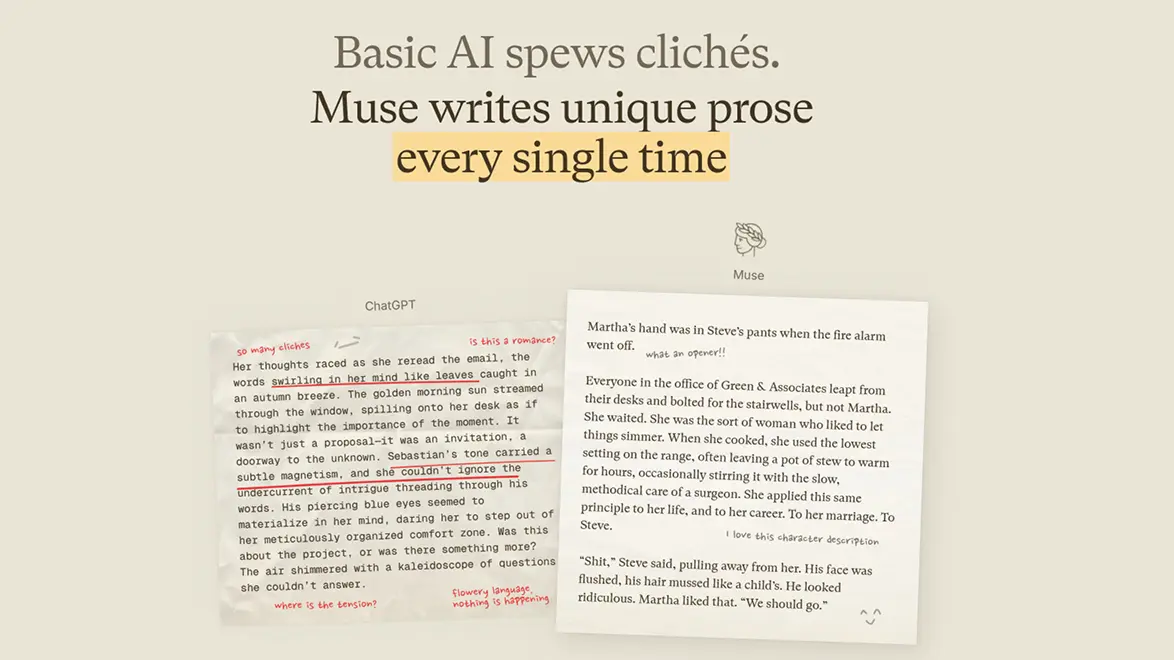
That specialization shows up immediately in the output quality. When a general AI writes a scene, you get something that technically works but reads like it was assembled from a manual. When Muse writes a scene, it understands blocking, pacing, dialogue rhythm, and even humor. Ask ChatGPT to add sensory details to a flat paragraph and you'll get generic descriptors. Muse adds specific details like the smell of burnt coffee or the texture of worn leather. The kind of details that actually make fiction feel real.
Muse also comes with a Creativity slider that lets you control how experimental the output gets. Set it low and the AI sticks closely to your instructions. Set it high and it takes creative liberties with wording and scene direction. Most writers find the sweet spot around 70 to 80% for a good balance of creativity and control.
Another major advantage: Muse has no content filters. General AI models often refuse to write violence, intense drama, or adult themes. Muse will write whatever your story needs. Whether you're writing dark thrillers, steamy romance, or gritty war fiction, the AI works with you instead of censoring your creative vision. For fiction writers, that alone can be a dealbreaker with other tools.
Try Sudowrite For FreeThe features that actually matter
Sudowrite has a lot packed into it. Here are the features that make a real difference in your day to day writing.
Write (Guided and Auto)
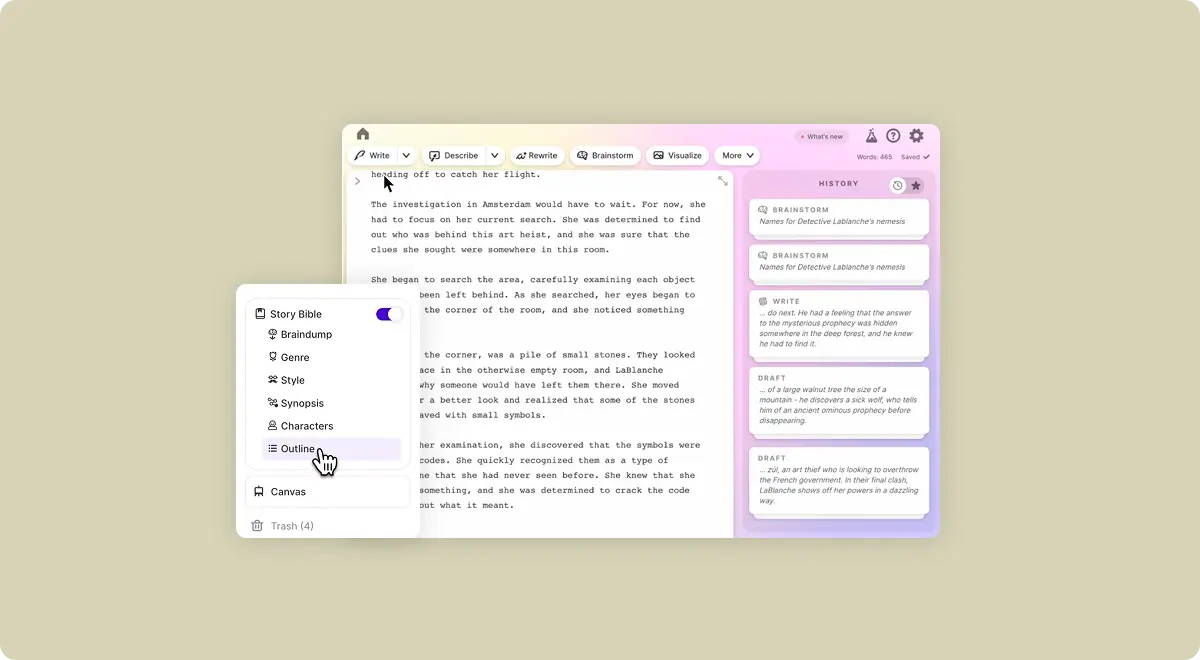
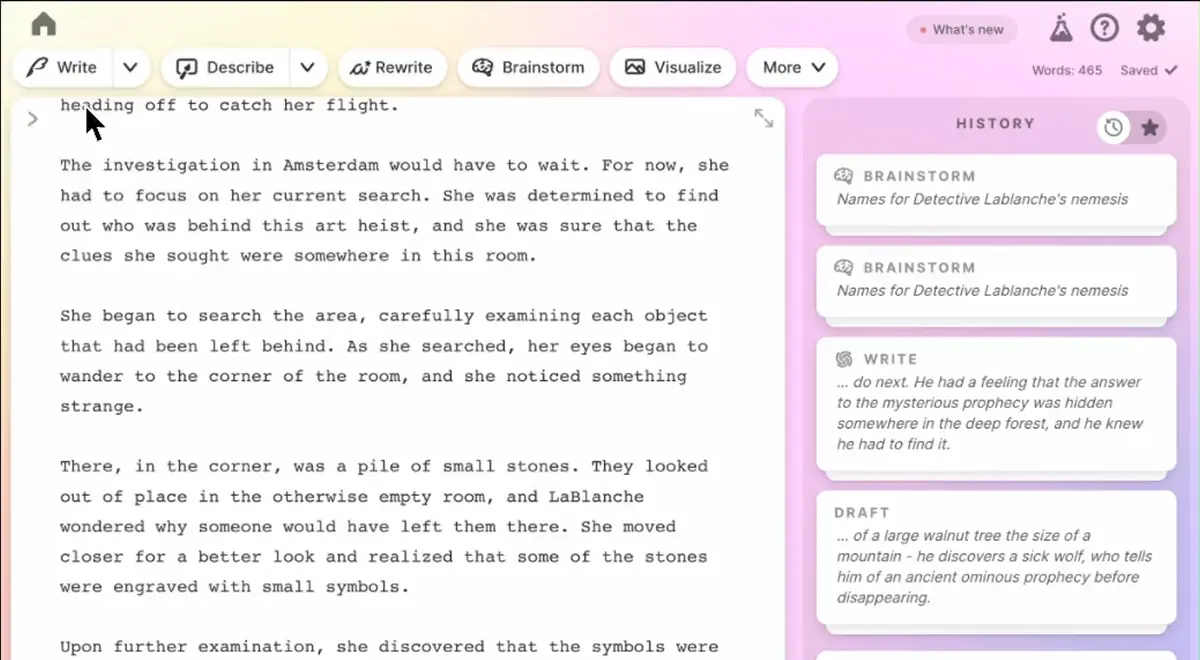
This is where most of the daily writing happens. Guided Write lets you type a sentence or two about what happens next, and Sudowrite generates up to 500 words based on that direction. Auto Write works the same way but without guidance, letting the AI decide where the scene goes. Combined with the Muse model, these tools handle the heavy lifting of getting words on the page when you know the direction but can't find the words.
Story Bible
This is one of the most underrated features. The Story Bible stores your characters, worldbuilding details, plot notes, and backstories in one place. When the AI generates new content, it references the Story Bible to maintain consistency. That means your character's eye color doesn't change between chapters and your magic system follows its own rules. For anyone writing a novel length project, this feature alone prevents hours of continuity editing.
Series Folder
If you write connected series or multi book projects, the Series Folder tracks characters, events, and world details across all your books. You can reference it when starting a new installment, and the AI pulls in established details automatically. Most authors manage this with spreadsheets and sticky notes. Having it built into the writing tool saves a surprising amount of time.
Describe and Expand
Describe takes flat passages and adds sensory details. Point it at a paragraph that says "they walked through the forest" and it generates options with smells, sounds, textures, and atmosphere. Expand takes compressed sections and builds them out with more detail or dialogue. Both are particularly useful during revision when you need to flesh out scenes that feel rushed.
Rewrite and Feedback
Rewrite offers multiple variations of any passage. You can ask for "show not tell" rewrites, more intense versions, or style shifts. Feedback analyzes your writing and gives you three actionable areas to improve. It's not a deep developmental edit, but it catches patterns you might miss on your own. Think of it as a beta reader who never gets tired and never worries about hurting your feelings.
Brainstorm and Canvas
Brainstorm generates character names, plot twists, and story directions on demand. Canvas is a visual planning tool that lets you explore plot points, character arcs, and themes. You can generate alternate story paths, character secrets, and plot twists without leaving the platform. For plotters who like to see their story structure visually, Canvas is a genuine time saver.
Want to see all these features yourself? Sudowrite offers a free trial with about 10,000 credits and no credit card required.
Try Sudowrite For FreeSudowrite pricing in 2026: what you'll actually pay
Sudowrite uses a credit based pricing system. All three plans give you access to every feature. The only difference is how many credits you get per month and whether unused credits roll over.
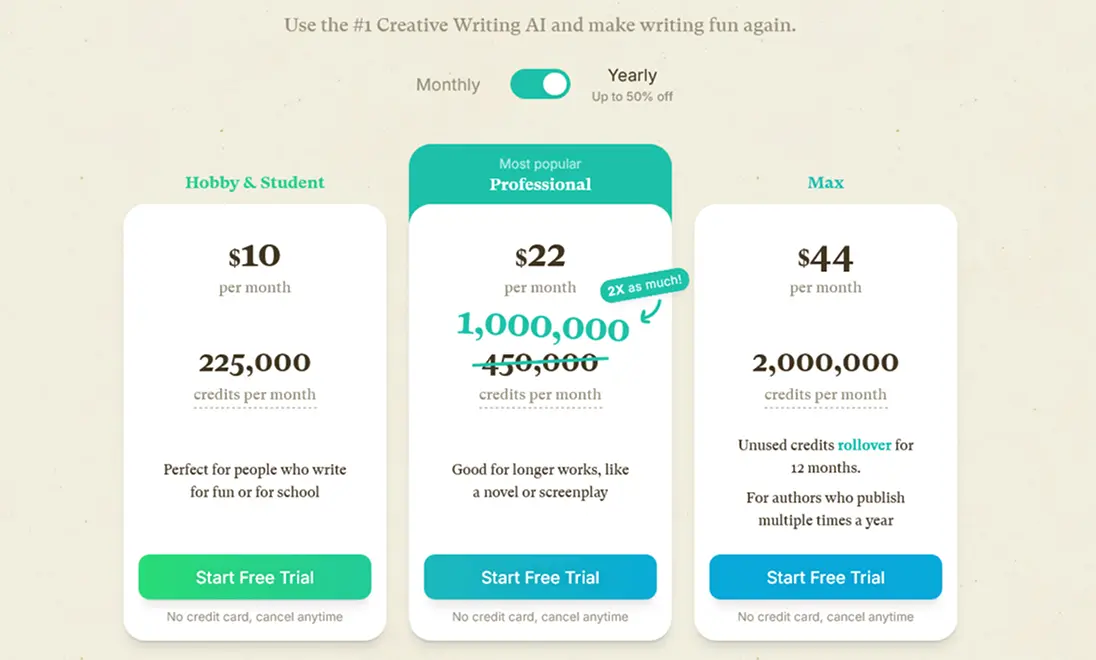
The Hobby & Student plan costs $19/month or $10/month billed annually (that's a 47% discount, the steepest of any tier). You get 225,000 credits per month, which translates to roughly 20,000 to 30,000 words of AI generated content depending on which models you use. This is enough for casual writers, students experimenting with AI assisted storytelling, or anyone producing under 30,000 words per month. Unused credits expire at the end of each billing cycle.
The Professional plan costs $29/month or $22/month billed annually. You get 1,000,000 credits, which is more than 4x the Hobby plan for roughly 1.5x the price. That's the sweet spot for most working writers. If you're actively drafting a novel, expect to use 600,000 to 1.5 million credits for a full manuscript depending on how heavily you rely on the AI. Credits still expire monthly on this plan.
The Max plan costs $59/month or $44/month billed annually. You get 2,000,000 credits plus the one feature neither lower tier offers: 12 month credit rollover. Your unused credits don't vanish at the end of the month. They accumulate. For writers whose output fluctuates between heavy drafting months and light editing months, this eliminates the "use it or lose it" pressure that frustrates users on lower tiers. Max also includes a free $49 personal setup session to help you get the most out of the platform.
There's also an Enterprise plan with custom pricing for publishing houses, writing programs, and organizations that need multi user access. You'll need to contact their sales team for a quote.
One thing that catches people off guard: credits don't translate to words 1:1. Different AI models consume credits at different rates. The Muse model, which produces the best fiction output, uses significantly more credits than lighter models like GPT 4o Mini. Heavy Muse users on the Professional plan report running out of credits mid month. If you plan to use Muse as your primary model, the Max plan is the safer bet.
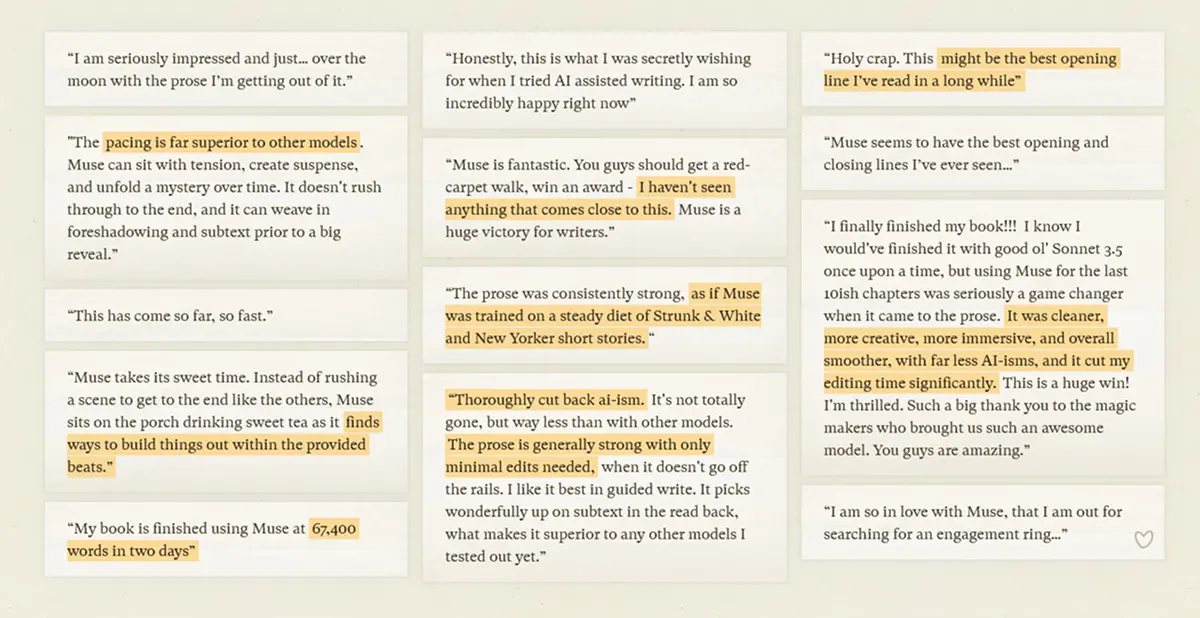
"I finally finished my book! Using Muse for the last 10 chapters was seriously a game changer. It was cleaner, more creative, more immersive, and it cut my editing time significantly."
— Sudowrite community member, Beta testerWhat real users are saying about Sudowrite
We went through user testimonials on the official Sudowrite community, Reddit's r/WritingWithAI, Trustpilot reviews, and feedback from published authors to see what the actual experience looks like.
The most consistent praise is about prose quality. Writers repeatedly highlight that Muse produces output that sounds like fiction, not like a chatbot trying to write fiction. One community member described the pacing as "far superior to other models" and noted that Muse can handle tension, suspense, and foreshadowing in ways that general AI simply can't.
Productivity gains come up constantly. Multiple users report finishing manuscripts 2 to 3x faster with Sudowrite handling the first draft iteration. One novelist mentioned writing 67,400 words in two days using the platform. That's extreme, but it illustrates the potential throughput when you use the tool as a drafting partner rather than trying to write everything yourself.
The most common complaints center on credit consumption. Users on the Hobby plan frequently mention running out of credits faster than expected, especially when using the Muse model. The credit system is intentionally opaque, and it takes trial and error to learn how different features consume your allocation.
The other recurring criticism is the learning curve. Sudowrite has a lot of features, and it takes 2 to 3 sessions (roughly 4 to 6 hours) to understand how everything fits together. The platform offers an introductory video that runs about an hour, and most users say watching it is worth the time investment.
Notable endorsements include Hugh Howey (bestselling author of Silo), Bernie Su (3 time Emmy winning screenwriter), and Chris Anderson (New York Times bestselling author). The platform has also been featured in The New York Times, The New Yorker, and The Washington Post.
Honest pros and cons
What we like
What could be better
How Sudowrite compares to other AI tools
There are several options for AI assisted writing in 2026. Here's how Sudowrite stacks up against the most relevant alternatives.
Sudowrite vs ChatGPT: This is the comparison most writers start with. ChatGPT Plus costs $20/month with unlimited usage, while Sudowrite starts at $10/month with credit limits. ChatGPT is a general purpose AI that can write fiction, but it wasn't built for it. Sudowrite's Muse model consistently produces better prose, understands scene structure, and avoids the generic phrasing that plagues ChatGPT fiction output. If you're serious about fiction, Sudowrite wins on quality. If you need unlimited AI for everything from emails to code to stories, ChatGPT is more versatile.
Sudowrite vs NovelCrafter: NovelCrafter is another fiction focused tool gaining traction. It gives you more control over prompt engineering and lets you bring your own API keys from services like OpenAI and Anthropic. That means potentially lower costs if you're technical enough to manage API usage. Sudowrite is more polished, easier to use out of the box, and the Muse model gives it an edge in prose quality. NovelCrafter appeals to writers who want maximum control. Sudowrite appeals to writers who want maximum ease of use. We have a detailed Rytr vs Sudowrite comparison that covers more about how Sudowrite stacks up.
Sudowrite vs Jasper: These tools serve completely different audiences. Jasper is built for marketing teams and content creators. It's excellent at blog posts, ad copy, and email campaigns but terrible at fiction. Sudowrite is the opposite. If you're a fiction writer, Jasper won't help you. If you need marketing content, Sudowrite won't either. Pick the one that matches what you actually write.
Sudowrite vs just using Claude or GPT directly: You can absolutely use Claude or GPT directly through their chat interfaces for fiction. It's cheaper (or free). But you lose all the fiction specific tooling: Story Bible, Series Folder, the Muse model, Describe, Expand, Canvas, and the integrated editor. Sudowrite's value isn't just the AI model. It's the workflow built around how fiction writers actually work. If you're comfortable prompt engineering your own fiction workflow in a chat window, you can save money. Most writers find the integrated toolset worth paying for.
Frequently asked questions
Yes. Sudowrite offers a free trial with approximately 10,000 credits and no credit card required. That's enough to test the core writing tools, experiment with the Muse model, and get a feel for how the platform works before committing to a paid plan.
Sudowrite has three plans. The Hobby and Student plan costs $19/month or $10/month billed annually with 225,000 credits. The Professional plan costs $29/month or $22/month annually with 1,000,000 credits. The Max plan costs $59/month or $44/month annually with 2,000,000 credits plus 12 month credit rollover. All plans include full access to every feature. Annual billing saves you up to 47%.
Muse is Sudowrite's proprietary AI model built specifically for fiction writing. Unlike general purpose models like ChatGPT, Muse was trained on published novels and short stories, so it understands scene structure, dialogue rhythm, and narrative pacing. The current version is Muse 1.5, and it powers most of Sudowrite's core writing features including Write, Draft, and Expand. It also has no content filters, meaning it can write any genre and any level of intensity.
Sudowrite can generate scenes, chapters, and extended passages from your outlines and story details. But the best results come from treating it as a creative partner, not a replacement. You provide the ideas, characters, and direction. Sudowrite helps you draft faster, brainstorm when you're stuck, and polish your prose. Writers who use it as a collaboration tool get far better output than those who try to automate the entire process.
For fiction writing specifically, yes. ChatGPT is a general purpose AI that handles everything from code to customer service emails. Sudowrite's Muse model was trained exclusively on fiction, so it produces better prose quality, understands scene blocking and pacing, and avoids the cliched language that general AI models tend to generate. ChatGPT Plus costs $20/month with unlimited usage, while Sudowrite starts at $10/month with credit limits. The tradeoff is quality versus quantity.
No. Sudowrite claims no rights over anything you put into the platform or anything it generates for you. Your writing stays yours. They also state that they do not use your writing to train their AI models. If you cancel your subscription, you can still access and export your projects. They will never hold your writing hostage.
Final verdict: is Sudowrite worth it in 2026?
For fiction writers, yes. Sudowrite is the best AI writing tool specifically designed for storytelling in 2026. The Muse model produces prose that sounds like an actual novelist wrote it, not like a chatbot that learned to string together pretty sentences. The Story Bible and Series Folder solve real problems that plague every author working on longer projects. And the no filter approach means you can write whatever your story demands without the AI policing your creative choices.
The biggest weaknesses are real but predictable. The credit system takes getting used to, and heavy Muse users will burn through the Hobby plan fast. The lack of export formats means you'll need Scrivener, Atticus, or Vellum to handle formatting. And the learning curve isn't trivial. You'll spend a few hours figuring out how everything connects before you hit your stride.
If you're on the fence, the free trial makes the decision easy. Sign up, test the Muse model on a scene you've been struggling with, try the Brainstorm tool for your next plot point, and see whether the output quality justifies the subscription. You'll know within an hour whether Sudowrite fits how you write. And if it does, the annual pricing at $10/month for Hobby or $22/month for Professional makes it one of the most affordable fiction tools on the market.
Ready to see if Sudowrite fits your writing process? The free trial includes about 10,000 credits, access to the Muse model, and every feature. No credit card needed.
Try Sudowrite For Free