

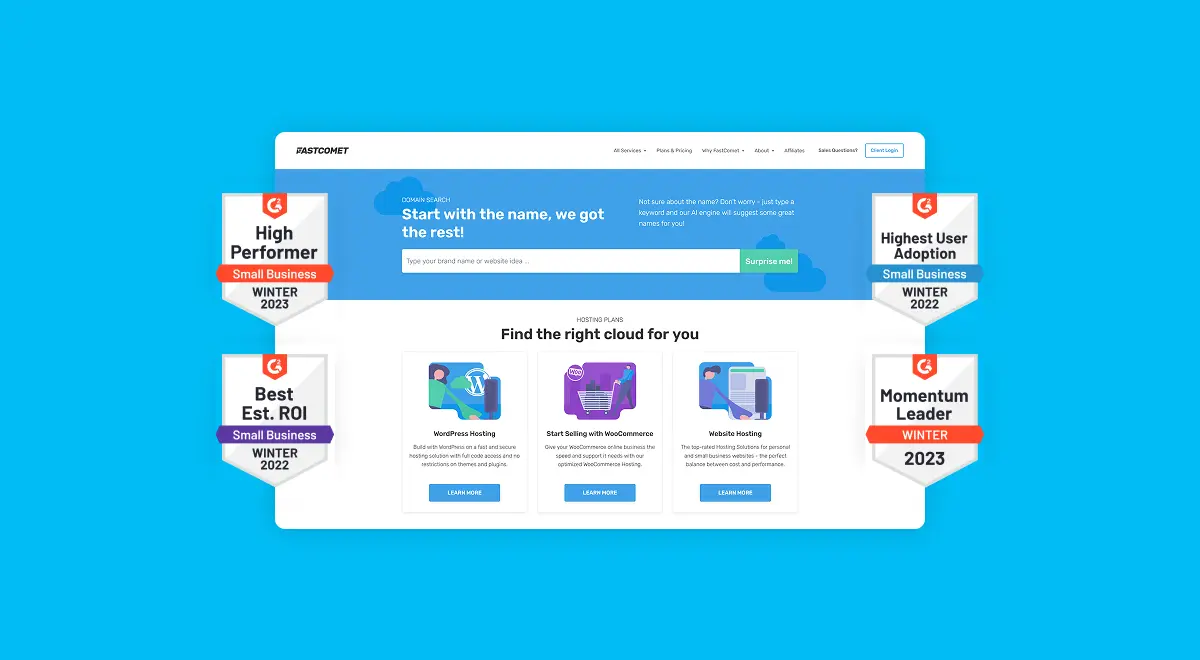
The Fastcomet web hosting company was quietly acquired by WorldHostGroup in late 2024, the same parent behind Hosting.com and Rocket.net. Your $1.79/month plan now runs on a completely different data center infrastructure than it did two years ago. That's a big deal. It's also the reason this review matters in 2026 and the ten-month-old reviews on the first page of Google don't.
So here's the real question: after the acquisition, the infrastructure swap, and the support team replacement, is FastComet still worth the money? Let's look at what the numbers actually say.
Try FastComet for 45 daysWhat is FastComet and what changed in 2026?
FastComet launched in 2013 as an independent budget cloud hosting provider focused on bundling premium-tier features into entry-level pricing. The company grew to serve over 50,000 customers across 83 countries, operating from 12 data center locations spread across North America, Europe, Asia, and Oceania.
Then late 2024 happened. FastComet was acquired by WorldHostGroup, the same company that owns Hosting.com, Rocket.net, and over 10 other hosting brands. The existing FastComet data center infrastructure was replaced with new servers shared with Hosting.com, and the original support team was replaced by WorldHostGroup staff. The FastComet brand, pricing, and feature set stayed the same, but the engine under the hood is different.
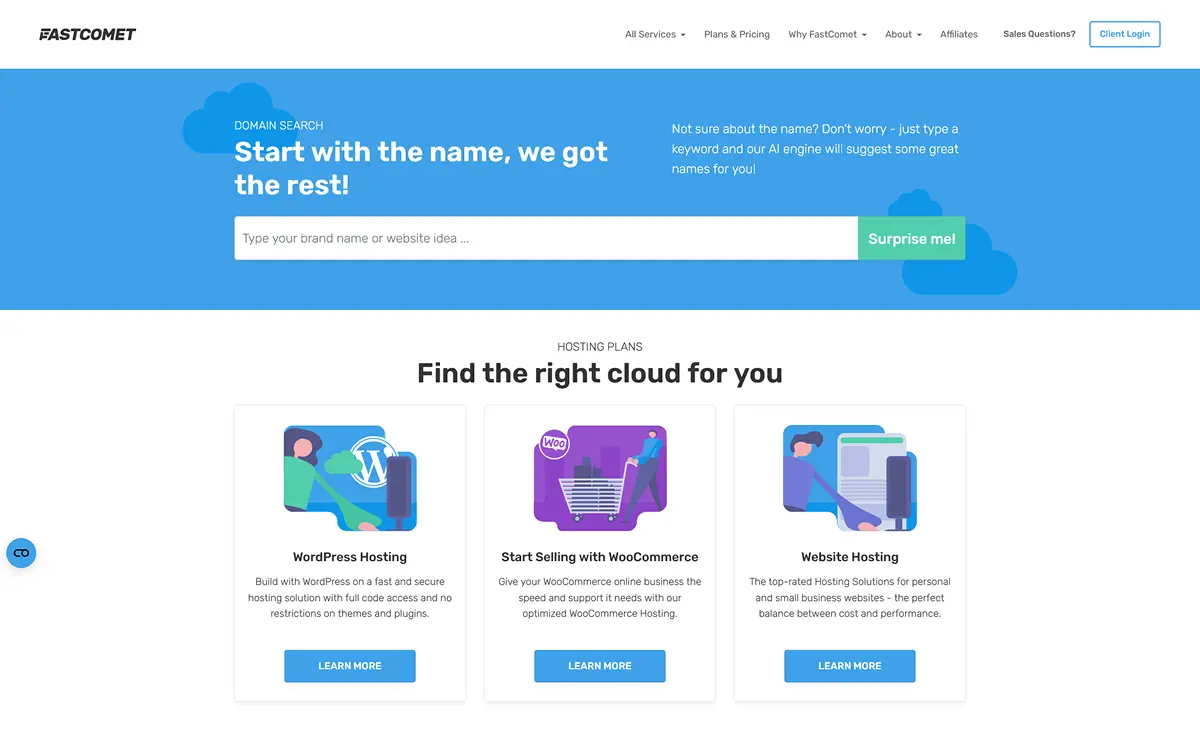
The technical stack itself is still solid. Every site runs on LiteSpeed Enterprise servers with NVMe SSD storage, managed through cPanel (the familiar control panel most developers already know). You get CloudLinux isolation so your account doesn't share resources with noisy neighbors, and Imunify360 security running in the background to catch malware before it lands. The dashboard is standard cPanel, not a custom interface, which is either a plus or a minus depending on how you feel about cPanel.
What actually separates FastComet from the rest of the budget hosting pack is the 12 data center locations. Most sub-$2 hosts give you one or two region choices. FastComet lets you pick from Dallas, Newark, Toronto, Fremont, Frankfurt, London, Milan, Singapore, Tokyo, Mumbai, Sydney, and Sao Paulo. If your audience sits in a specific region, you can host closest to them without paying premium prices.
Who is FastComet built for?
FastComet works best for budget-conscious site owners, small businesses, bloggers, and developers who want a complete hosting package without paying enterprise prices. The starter plan at $1.79/month comes bundled with email hosting, daily backups, free SSL, and a free Cloudflare CDN integration. Most competitors charge extra for at least one of those.
Personal site owners and solo bloggers get real value here. One website, 10GB NVMe storage, unlimited bandwidth, and free email for under $2/month is genuinely fair. The 45-day money-back guarantee means you can test it for six weeks before committing.
Small businesses and freelancers managing multiple sites are the sweet spot for the Plus plan at $3.59/month. Unlimited websites, 30GB storage, and 50,000 monthly visits per site. If you're running more demanding projects, our Kinsta review covers the managed WordPress option for scaled-up needs.
FastComet is probably not the right pick for high-traffic WooCommerce stores, SaaS marketing sites, or sites that need enterprise-grade global performance. Server hardware allocation is below the industry average and there's no built-in edge CDN. For revenue-critical sites, a host with stronger hardware and dedicated CDN is a better spend.
The features that actually matter
FastComet advertises a long feature list. Most budget hosts do. Here are the features that actually affect your day-to-day site management and what they're really worth.
12 data center locations across 4 continents
This is FastComet's best feature and it's genuinely underrated. You get to choose from 12 locations at signup: Dallas, Newark, Toronto, Fremont, Frankfurt, London, Milan, Singapore, Tokyo, Mumbai, Sydney, and Sao Paulo. Most shared hosts force you into 1 or 2 US data centers. If your audience is in Southeast Asia or Latin America, this alone can shave 200ms+ off your TTFB compared to hosting from the US. Location choice is a single-server decision though, not CDN-style edge caching, so it helps nearby visitors more than global audiences.
Free email hosting on every plan
Most budget hosts either charge separately for email or hide it behind an expensive upgrade. FastComet includes unlimited email accounts with 10GB per mailbox on every shared plan, even Starter at $1.79/month. You get spam filtering, virus protection, webmail access, and full SMTP/IMAP so you can use Outlook, Apple Mail, or Gmail. For a business running email on a custom domain, this saves roughly $6/user/month compared to Google Workspace.
Daily backups included, not weekly
FastComet runs free daily backups on every plan with 7-day retention on Starter, scaling up to 30-day retention on Extra. Restoring is one click from cPanel. Bluehost gives you weekly backups on shared plans (which is a terrible cadence if you break something Tuesday morning). The daily cadence is a real trust-building feature, especially for sites that update often or take user data.
LiteSpeed Enterprise caching plus Imunify360 security
The server stack uses LiteSpeed Enterprise, which is meaningfully faster than Apache or NGINX for WordPress. Paired with the LSCache plugin, you get full-page caching at the server level without needing a third-party caching tool. Imunify360 runs in the background, scanning for malware, blocking brute-force attempts, and cleaning infected files automatically. Together, these two tools handle roughly 80% of what a site owner would otherwise need to bolt on manually.
Want to try FastComet without long-term commitment? The 45-day money-back guarantee is one of the most generous refund windows in the hosting industry. You can sign up, migrate your site, run it live for six weeks, and still get a full refund if it's not a fit.
Start with FastComet NowFastComet pricing in 2026: what you'll actually pay
FastComet's pricing is transparent at signup and then jumps hard at renewal. Here's the honest breakdown of what you pay now versus what you'll pay in year two.
Start by picking a term length. The annual plan gets you the $1.79/month rate for the first year. The triennial (3-year) plan locks it in for 36 months, which is the smart move if you're confident after the 45-day trial window.
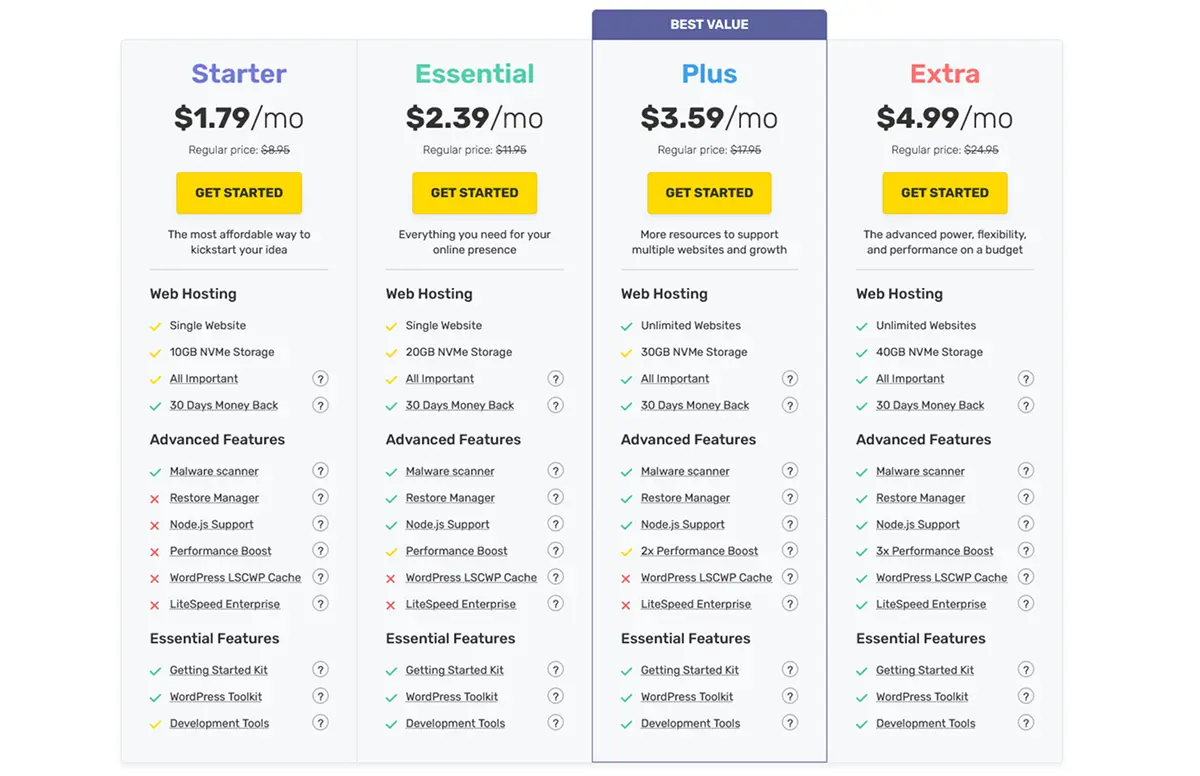
The Starter plan at $1.79/month is the entry point: 1 website, 10GB NVMe SSD, unlimited bandwidth, free email, daily backups with 7-day retention, and the full LiteSpeed and Imunify360 stack. Fine for a single blog or portfolio under 20,000 monthly visits.
The Essential plan at $2.39/month bumps you to 20GB storage and 25,000 monthly visits but still caps you at 1 website. Unless you specifically need more storage, skip this tier and go straight to Plus.
The Plus plan at $3.59/month is where most serious users actually land. Unlimited websites, 30GB NVMe storage, 50,000 monthly visits per site, and 15-day backup retention. For an extra $1.20/month over Starter, you unlock multi-site hosting. If you're running a business, a side project, and a staging site, Plus is the smart buy.
The Extra plan at $4.99/month covers unlimited sites, 40GB storage, 100,000 monthly visits per site, and 30-day backup retention. Small agencies and developers managing multiple client sites typically land here.
One thing to know upfront: renewal pricing is significantly higher. Starter renews at $8.95/month (5x jump), Essential at $11.95, Plus at $17.95, and Extra at $24.95. The smart play is locking in the 3-year term at signup so you keep the intro rate for 36 months before renewal kicks in.
"I took advantage of your support and I must say, it is the perfect one. It is very fast, servers reliability is incredible and dedicated servers are setup and configured very quickly. Honestly, you are particularly good for small and big websites!"
— Jonas Pranio, Entrepreneur at InyCloudSpeed and support: the honest numbers
Every hosting company claims "blazing fast" and "expert 24/7 support." Here's what the independent benchmark data actually shows for FastComet in 2026.
On speed, the numbers are mixed. Independent testing from Hostingstep shows FastComet's US TTFB at 525ms, slightly below the field median of 465ms across 34 hosts tested. Uptime is the strong point at 99.98% in Q4 2025, putting FastComet in the top tier for reliability. The load test was a clean pass: 78ms average with 0% errors when hit with 100 concurrent visitors.
The weaker metrics are hardware and global delivery. WPBench hardware scored 4.8 out of 10, below the field average of 6.4. This matters for WooCommerce stores and any WordPress setup running 20+ plugins. Global TTFB averages 521ms because FastComet doesn't bundle an edge CDN. Asia-Pacific delivery from a US origin hits 881ms, which is poor for that region.
The workaround is simple: pick the data center closest to your actual audience. Hosting from Singapore or Tokyo instead of Newark drops Asia-Pacific TTFB dramatically. For global audiences, layer free Cloudflare CDN on top (FastComet has one-click integration).
On support, FastComet consistently gets praised by users. Live chat responds in under 1 minute most of the time and the team handles real technical issues. With the WorldHostGroup acquisition, the support team was replaced, but response times and quality ratings have stayed high through Q1 2026.
What real users are saying in 2026
We went through recent reviews on Trustpilot, Google, HostAdvice, and HRating to see what actual FastComet customers think in 2026.
The platform holds a 4.8 out of 5 on Trustpilot from 3,206 reviews, a 5/5 on Google from 217 reviews, a 5/5 on HostAdvice from 1,501 reviews, and a 4.5/5 on HRating from 60 reviews. The review volume alone is telling. FastComet has more Trustpilot reviews than most hosts 3x its size.
The most consistent praise goes to customer support quality, migration assistance, and uptime reliability. One recurring pattern: users mention support agents by name. That's rare in hosting reviews and usually signals a support team that actually owns their tickets.
Common complaints are predictable. Renewal pricing comes up in nearly every critical review. The 5x jump from $1.79 to $8.95 on the Starter plan catches users off guard. A handful of reviews also mention hardware limitations for resource-heavy sites, which matches the independent WPBench data.
"The technical service was simply great and fast. Even too fast! I started working on my new website on my vacation time, during the Christmas time, and I was assisted on a weekend evening during that period. I thought it was crazy when the customer service answered on the chat me instantly!"
— Andrea Belfi, MusicianHonest pros and cons breakdown
So is FastComet good across the board or are there real trade-offs? Here's the straight take after reviewing pricing, features, user feedback, and independent benchmark data.
What we like
What could be better
Who should use FastComet (and who shouldn't)
FastComet is a strong choice if you run a personal blog or small business site on a tight budget, need free email and daily backups bundled without surprise add-ons, host an audience in a specific non-US region like Singapore or Sao Paulo, or want a familiar cPanel setup without breaking $5/month. The 45-day refund window makes testing genuinely risk-free.
Skip FastComet if you run a high-traffic WooCommerce store, need sub-300ms global TTFB without CDN configuration, host a resource-heavy WordPress site with 20+ plugins, or prioritize infrastructure stability over budget pricing (the WorldHostGroup transition uncertainty is real). For those use cases, our Kinsta review covers the premium managed WordPress option, and our Namecheap review covers a similarly budget-priced alternative without the acquisition uncertainty.
How FastComet stacks up against the competition
FastComet competes in the budget shared hosting space against Hostinger, Bluehost, and Namecheap. Here's the honest comparison based on independent benchmark data and pricing.
FastComet vs Hostinger. Hostinger Business wins on raw speed with 478ms TTFB vs FastComet's 525ms, plus stronger hardware (7.4 WPBench vs 4.8) and a built-in CDN for 223ms global TTFB. FastComet wins on bundled features, included email (Hostinger charges extra), daily backups (Hostinger offers daily too), and 12 data centers vs Hostinger's smaller footprint. If speed matters most, Hostinger at $3.69/month beats FastComet at $1.79. If you want email and backups included at rock-bottom pricing, FastComet wins on the bundle.
FastComet vs Bluehost. Bluehost starts at $3.99/month and offers nearly double the hardware allocation (9.6 WPBench vs 4.8). That's the real differentiator. Bluehost also has a built-in static CDN for better global delivery. FastComet wins on daily backups (Bluehost gives you weekly), included email (Bluehost charges extra), uptime (99.98% vs 99.95%), and intro price. For hardware-heavy WordPress sites, Bluehost is the better infrastructure pick. For budget users who need email and daily backups, FastComet wins on value.
FastComet vs Namecheap. This is the closest comparison. Both hosts sit under $2/month, both include email and daily backups, and both lack a built-in CDN. Namecheap is 63ms faster on US TTFB (462ms vs 525ms) and slightly better on hardware (5.0 vs 4.8). FastComet has 12 data centers vs Namecheap's 2, and better load handling (78ms vs 150ms). If you need a specific non-US region, FastComet wins. For a US-based audience, Namecheap is slightly faster.
How to get started the smart way
Signing up for FastComet is straightforward, but a few moves separate a good signup from one you'll regret in year two.
Start by picking the right plan based on how many sites you'll host. Starter at $1.79/month is fine if you only ever plan to run one site. If you see any chance of running more (personal blog plus side project plus staging), jump straight to Plus at $3.59/month.
Next, pick your data center at checkout based on where your audience actually lives. North American traffic does well on Dallas, Newark, or Toronto. European audiences pick Frankfurt, London, or Milan. Asian traffic goes to Singapore, Tokyo, or Mumbai. This single choice can save you 200ms+ on TTFB.
The big move: choose the 3-year billing term. The intro rate locks in for the full 36 months. If you go annual, you renew at 5x the price after 12 months. The 3-year option saves roughly $200 and gives you time to either stay happy or migrate out. You get the full 45-day money-back guarantee regardless of term length.
After signup, request the free website migration from your dashboard. Fill out the form with your current host's credentials, FastComet's team moves the site to a staging URL, you verify it works, and they push it live. No plugin, no Git, no late-night DNS panic.
"FastComet has been exceptional and I couldn't be happier. They have helped me with several issues on my sites. Just off the top of my head they've helped me with email, site speed, addressing issues that have popped up on analytics and webmaster tools. I've been very pleased with their support."
— Michael Quinn, Founder & CEO of Life Insurance BlogFrequently asked questions
FastComet is good if you want a budget host that bundles free email, daily backups, and a free CDN into plans starting at $1.79/month. It holds a 4.8/5 Trustpilot rating from over 3,206 reviews and 99.98% uptime, which is genuinely strong for this price tier. The trade-offs are real though. Server hardware allocation is below the field average, there's no built-in edge CDN, and renewal pricing jumps to $8.95/month on the starter plan. For a small blog, portfolio, or non-US audience site, FastComet delivers solid value. For a hardware-heavy WooCommerce store or global site that needs fast worldwide delivery, there are faster options at similar or slightly higher prices.
FastComet shared hosting plans start at $1.79/month for Starter, $2.39/month for Essential, $3.59/month for Plus, and $4.99/month for Extra when billed annually. Renewal rates jump to $8.95, $11.95, $17.95, and $24.95/month respectively. Cloud VPS plans start at $46.16/month and dedicated CPU servers start at $107/month. Every plan includes free SSL, daily backups, free email hosting, free Cloudflare CDN integration, Imunify360 security, and a 45-day money-back guarantee.
FastComet wins on included features. You get free email, daily backups, and 12 data center locations at $1.79/month while Hostinger and Bluehost charge extra for email or only offer weekly backups. Hostinger Business beats FastComet on raw speed with better global TTFB and stronger hardware at $3.69/month, so if pure performance matters more than email inclusion, Hostinger has the edge. Bluehost offers nearly double the hardware allocation at $3.99/month. FastComet is the right pick for budget users who need email and backups bundled. Hostinger is the right pick for speed-first users. Bluehost is the right pick for hardware-heavy WordPress sites.
FastComet's pros include budget pricing starting at $1.79/month, free email hosting with unlimited accounts, daily backups included on every plan, 12 global data centers, LiteSpeed Enterprise caching, Imunify360 security suite, free Cloudflare CDN integration, 24/7 live chat support with under 1 minute response times, and a generous 45-day money-back guarantee. The cons are real too. Renewal prices jump up to 5x the intro rate, server hardware allocation is below the field average at 4.8 on WPBench, there's no built-in edge CDN so global TTFB can be slow in Asia-Pacific, and the recent WorldHostGroup acquisition in late 2024 changed the infrastructure and support team.
FastComet was acquired by WorldHostGroup in late 2024, the same parent company behind Hosting.com, Rocket.net, and over 10 other hosting brands. The original FastComet data center infrastructure has been replaced with new servers shared with Hosting.com, and the support team has been replaced by WorldHostGroup staff. Early performance data from the transition period showed some uptime issues in 2024, but Q4 2025 data shows uptime recovered to 99.98%. FastComet still operates as a distinct brand with its own pricing and feature set. If you're risk-averse about ownership transitions, this is worth knowing before committing to a long-term plan.
FastComet does not offer a traditional free trial, but it offers a 45-day money-back guarantee on all shared hosting plans, which is one of the most generous refund windows in the industry. You can sign up, migrate your site, run it live for up to 45 days, and get a full refund if it's not the right fit. Free website migration is also handled by FastComet's team at no cost, so you can test the actual experience without the usual switching headaches. Most competitors offer 30-day guarantees at most, so FastComet's 45-day window gives you real time to evaluate.
Final verdict: is FastComet worth it in 2026?
So, is FastComet worth it in 2026 after the WorldHostGroup acquisition? Yes, for the right use cases. Not as a universal pick, but as the honest value play for budget site owners who need bundled features without playing the add-on upsell game.
The platform's biggest strengths are the 12 data center locations (genuinely rare at this price tier), the included email and daily backups (a real $60-80/year value bundled into the base plan), and the 45-day money-back guarantee (the most generous refund window in hosting, not marketing fluff).
The biggest weaknesses are honest limitations. Renewal prices hit 5x the intro rate, the WPBench hardware score of 4.8 trails the field average, and there's no built-in edge CDN for global delivery. The WorldHostGroup acquisition adds some infrastructure uncertainty that won't fully resolve until Q2 2026 data lands.
If you've been considering it, the 45-day money-back guarantee is the cleanest way to evaluate fit. Sign up on the 3-year term to lock in intro pricing, request the free migration, and run your site live for six weeks. If speed, uptime, and support hold up, stay and you've got the rate locked in for 36 months. If anything's off, you get a full refund with no hassle. For budget-conscious site owners in 2026, FastComet earns its spot as a genuinely fair value pick.
FastComet starts at $1.79/month with a 45-day money-back guarantee and free website migration. If you're running multiple sites, the Plus plan at $3.59/month unlocks unlimited websites, 50,000 monthly visits per site, and the full LiteSpeed and Imunify360 stack.
Get started now