

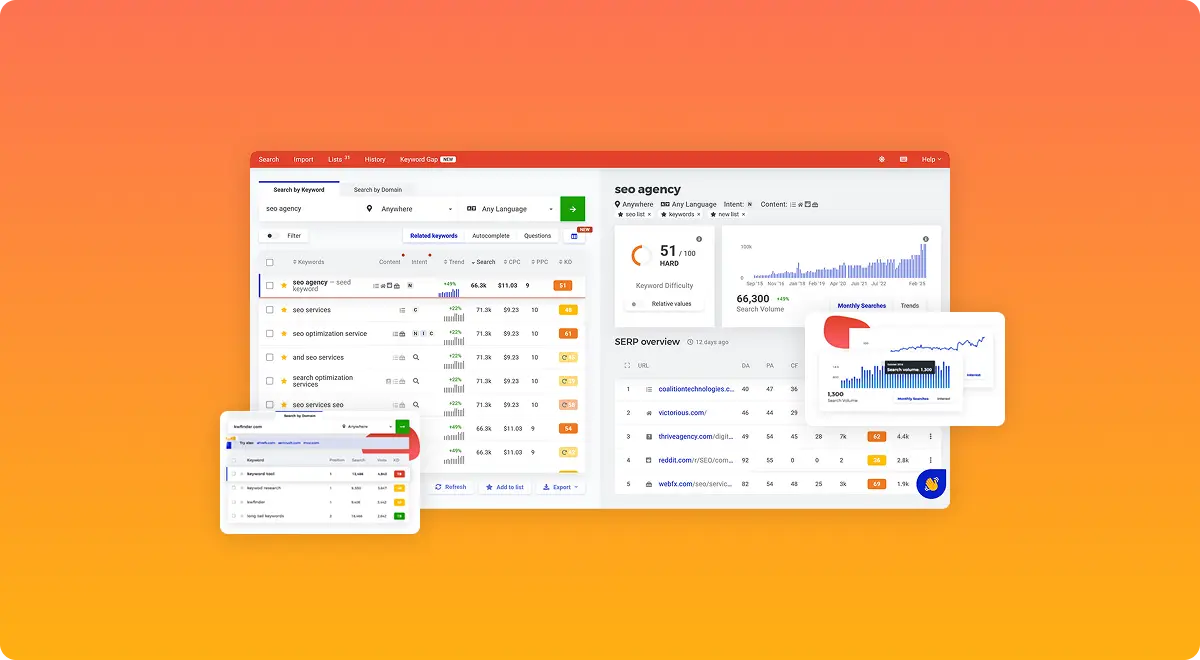
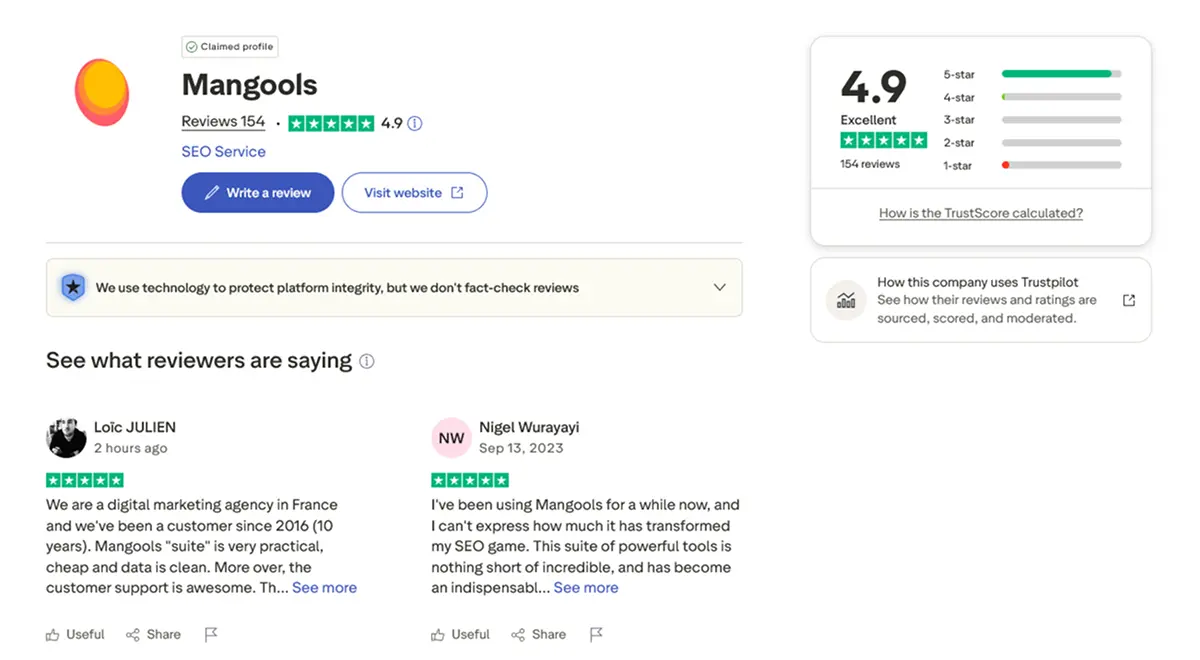
Mangools holds a 4.9 out of 5 on Trustpilot with 94% of users giving it five stars. Out of 153 reviews, nearly every single person rates it perfect. The platform packs five SEO tools into one dashboard, covers 2.5 billion keywords across 65,000+ locations, and the Basic plan starts at $29.90/month. In 2026 they also launched AI Search Watcher, which tracks how your brand shows up in ChatGPT, Gemini, and other AI search engines. But it's also missing a site audit tool, has a smaller keyword database than Ahrefs or Semrush, and the daily usage limits on the cheaper plans can feel tight. Here's everything you need to know before signing up.
Create a FREE accountWhat is Mangools?
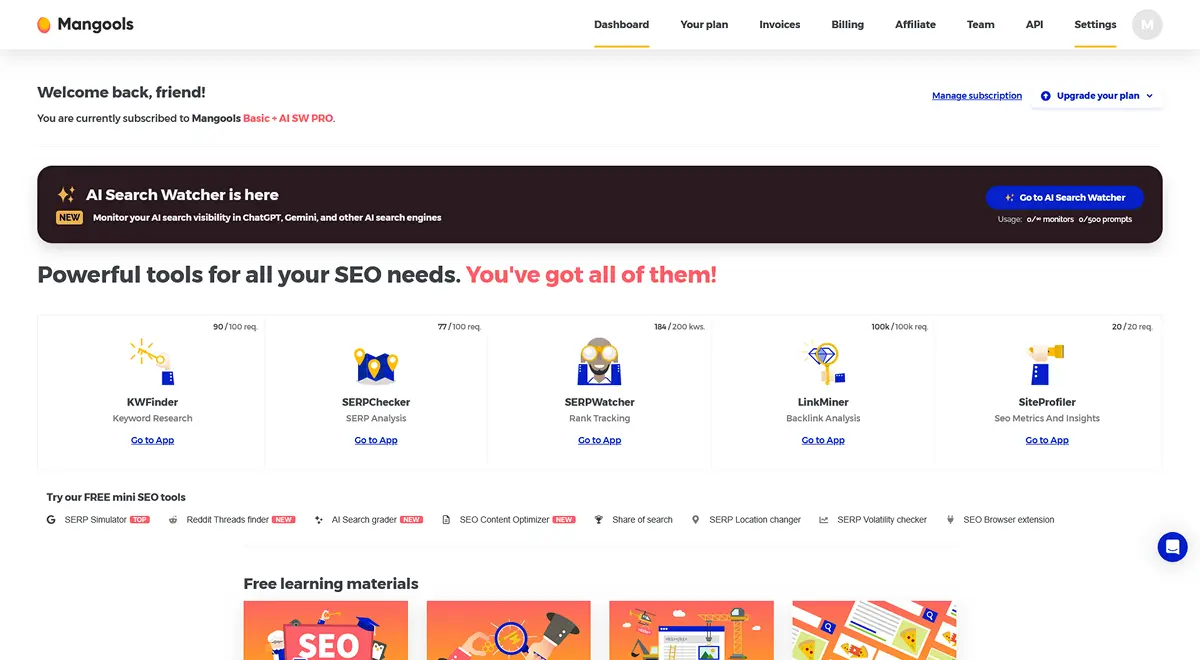
Mangools is an all in one SEO software suite built around five specialized tools: KWFinder for keyword research, SERPChecker for SERP analysis, SERPWatcher for rank tracking, LinkMiner for backlink analysis, and SiteProfiler for competitor insights. Everything runs from a single web dashboard with a shared login, so you're not bouncing between different platforms.
The company was founded in 2014 in Bratislava, Slovakia by Peter Hrbáčik. What started as a side project with just KWFinder has grown into one of the most popular budget SEO platforms in the world. Mangools is completely bootstrapped with zero venture capital funding, which is rare in the SaaS space. The parent company itrinity generated $25 million in revenue in 2024, and the platform now serves over 2.8 million registered users including teams at Airbnb, Adidas, and Skyscanner.
What sets Mangools apart from competitors like Ahrefs and Semrush is the simplicity. It scores 9.7 out of 10 for ease of use on G2, significantly higher than either competitor. You don't need to watch hours of tutorials or read documentation to get started. Open KWFinder, type a keyword, and you immediately see search volume, keyword difficulty, trends, CPC, and a full SERP overview with competitor metrics. That accessibility is why beginners love it, but it's also why experienced marketers keep it in their stack alongside bigger tools.
The other differentiator is pricing. At $29.90/month on the annual plan, Mangools costs roughly a third of what Ahrefs charges and about a fifth of Semrush. You're not getting the same depth of data (we'll be honest about that later), but for most bloggers, freelancers, and small businesses, Mangools covers 90% of what you actually need day to day.
Who is Mangools built for?
Mangools works best for people who need solid SEO data without the complexity or the price tag of enterprise tools. If you're a blogger figuring out which keywords to target, a freelance marketer managing a handful of client sites, or a small business owner who wants to track rankings and find content opportunities, this is built for you.
Bloggers and content creators get the most value here. KWFinder makes it dead simple to find low competition keywords with real search volume. You type in a seed keyword, and within seconds you have hundreds of related terms sorted by difficulty. The color coded KD score (green for easy, red for hard) means you don't need to interpret complex metrics. If it's green, you can probably rank for it. If it's red, move on unless your site has serious authority.
Affiliate marketers will appreciate the pricing comparison. When you're running multiple niche sites and your margins matter, paying $29.90/month instead of $139.95/month for Semrush means more budget for content and link building. Mangools handles keyword research, competitor backlink analysis, and rank tracking, which covers the core workflow for most affiliate operations.
Small marketing agencies can use the Premium ($44.90/month) or Agency ($89.90/month) plans to serve multiple clients. The Agency plan includes 5 team seats at $12/month each for additional users, 1,500 tracked keywords across unlimited domains, and 1,200 keyword lookups per day. That's enough for a boutique agency managing 10 to 20 client sites comfortably.
On the other hand, if you need technical site audits, Mangools isn't for you. There's no crawler that checks for broken links, missing meta tags, or page speed issues. If you run a large ecommerce site with thousands of product pages and need deep crawl data, you'll want Ahrefs or Screaming Frog. And if you need data from Bing, YouTube, or Amazon, Mangools is Google only.
The 5 core tools explained
Every Mangools plan gives you access to all five tools. The only difference between plans is how much you can use them per day. Here's what each one actually does and whether it's worth your time.
KWFinder: keyword research
This is the tool that put Mangools on the map, and it's still the strongest reason to subscribe. KWFinder searches a database of 2.5 billion keywords across 65,000+ locations in 40+ languages. You enter a seed keyword or a competitor's domain, and it returns a list of related terms with exact search volumes, keyword difficulty scores, CPC data, SERP features, and trend graphs.
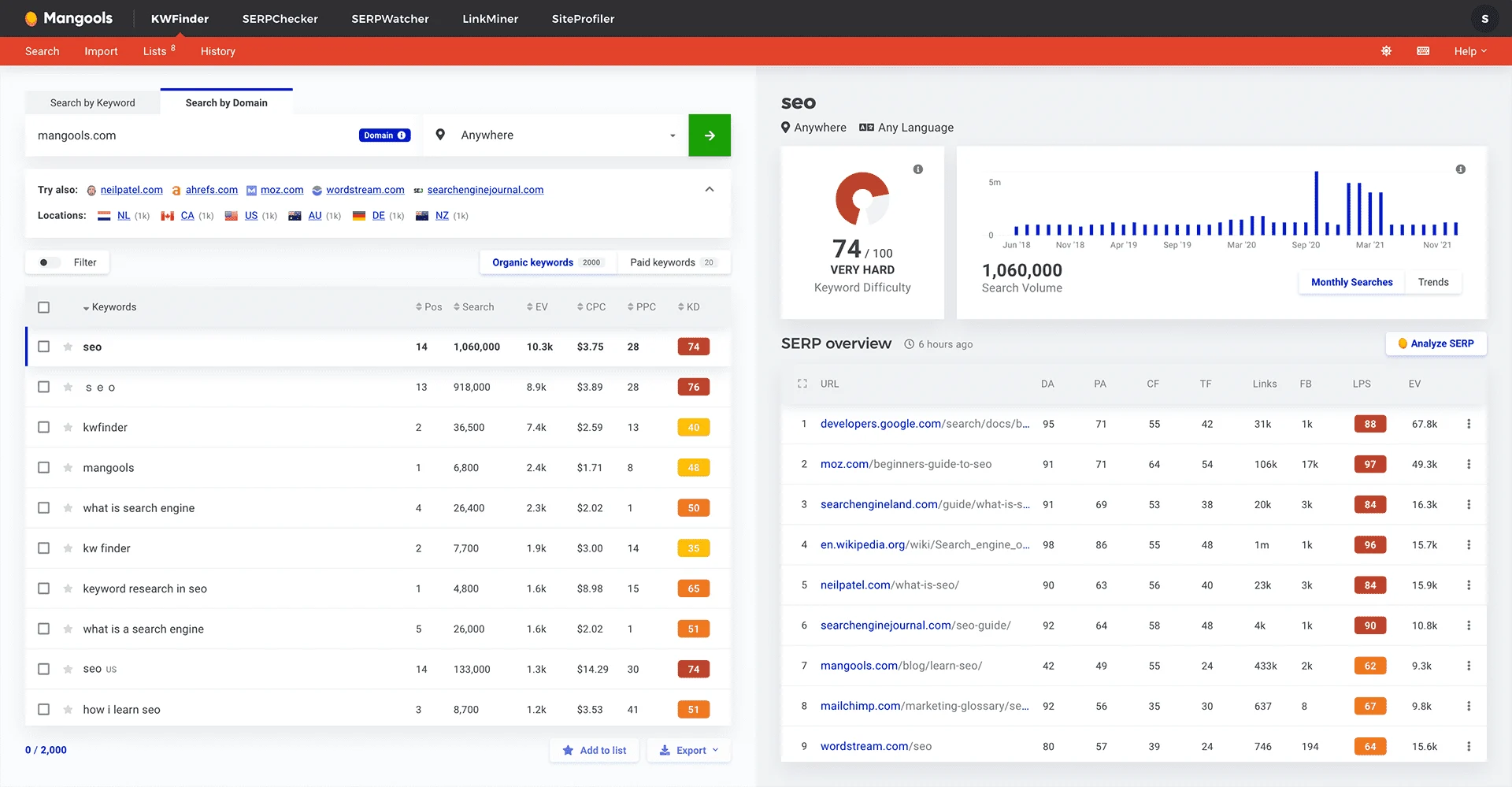
The keyword difficulty (KD) score is what makes KWFinder genuinely useful for beginners. It uses a 0 to 100 scale with clear color coding: green means you have a realistic shot at ranking, yellow means it's possible with effort, and red means you're probably wasting your time unless you have serious domain authority. It's not just a random number either. Mangools calculates it by analyzing the authority metrics of the pages currently ranking, so the score reflects the actual competitive landscape.
You can search by keyword (with Related, Autocomplete, and Questions modes) or by domain to spy on competitors' rankings. The domain search is particularly useful. Enter a competitor's URL and KWFinder shows you every keyword they rank for, which you can then filter by position, volume, or difficulty. That's how you find gaps in your content strategy without guessing.
On the Basic plan you get 100 keyword lookups per day with 200 keyword suggestions per search. For a solo blogger writing 3 to 5 articles per week, that's plenty. You'd need to be running heavy research sessions every single day to hit that cap. The Premium plan bumps it to 500 lookups with unlimited suggestions, which is where agencies and power users should start.
SERPChecker: SERP analysis
SERPChecker lets you analyze the search results for any keyword in any of the 65,000+ supported locations. It shows you the top ranking pages along with 45+ SEO metrics including Domain Authority, Page Authority, Citation Flow, Trust Flow, external links, Facebook shares, and Mangools' own Link Profile Strength (LPS) score.
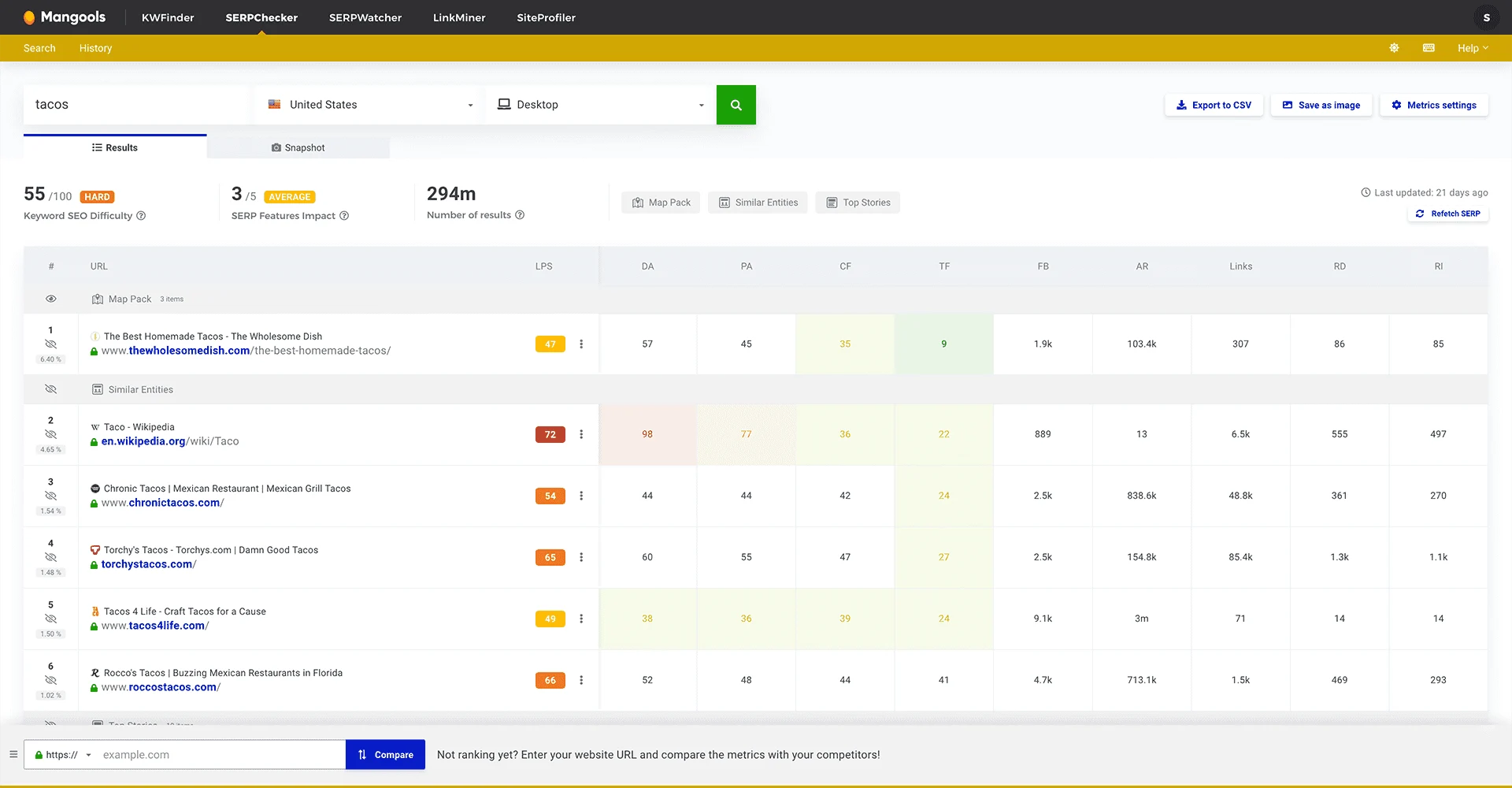
The most useful feature here is the SERP Features Impact score. Google's results pages aren't just 10 blue links anymore. Featured snippets, People Also Ask boxes, knowledge panels, and AI Overviews all eat into organic click through rates. SERPChecker calculates how crowded the SERP is with these features so you can decide if a keyword is actually worth targeting. A keyword with 1,000 monthly searches but a heavily featured SERP might deliver fewer clicks than a 200 volume keyword with clean organic results.
You can also compare your own URL against the current top results. This gives you a clear picture of the authority gap between your site and the competition, which helps you prioritize where to build links and which battles to fight.
Honestly, SERPChecker overlaps with KWFinder since the SERP overview is already visible inside the keyword research tool. But for dedicated SERP deep dives and local SERP analysis across different cities and countries, it earns its place.
SERPWatcher: rank tracking
SERPWatcher tracks your keyword rankings daily with updates pushed to your dashboard every 24 hours. You can track rankings across desktop and mobile, in any of the 65,000+ locations, and it sends you email alerts when significant changes happen.
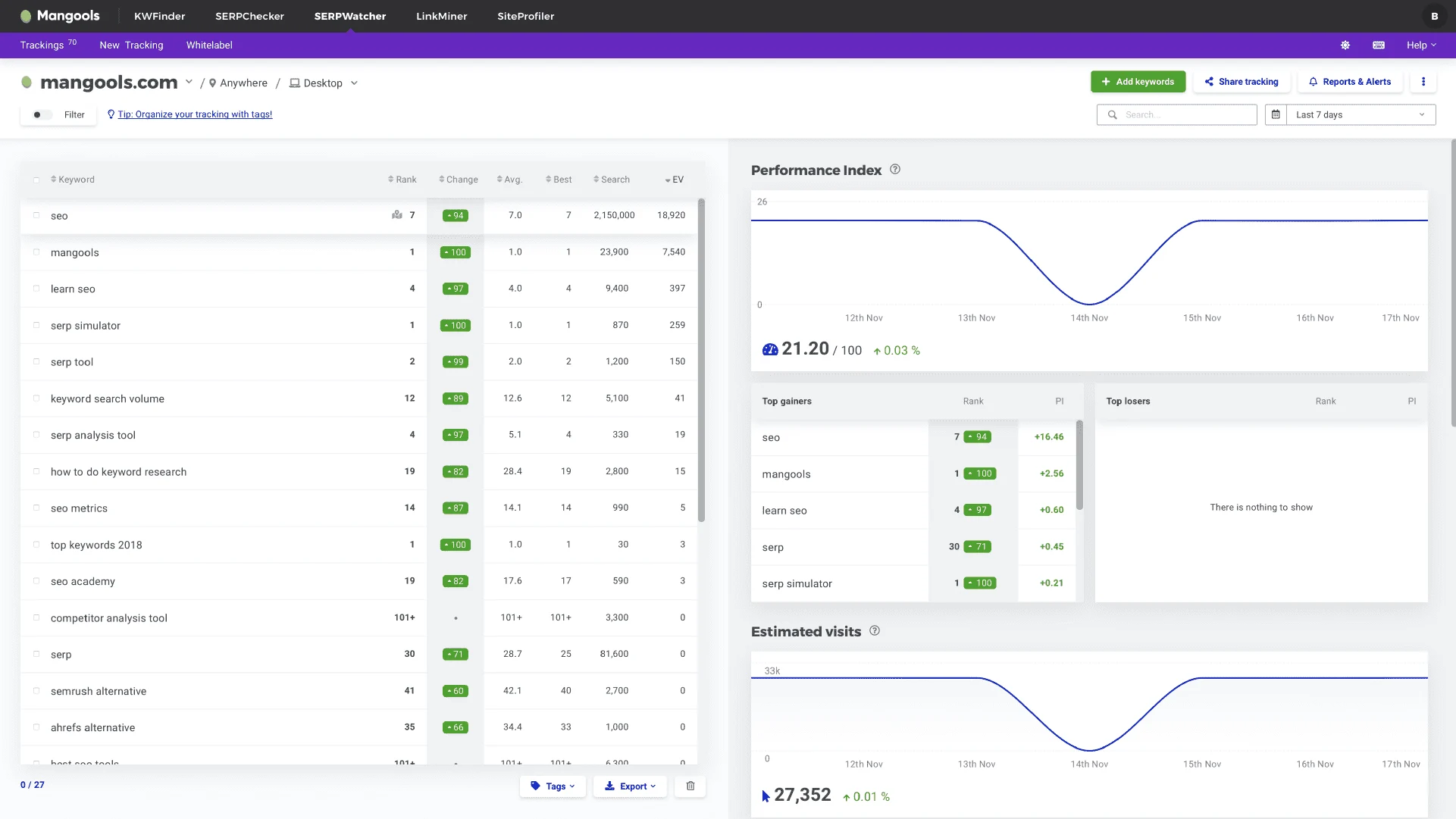
The dashboard shows each keyword's current rank, position changes over time, best historical rank, search volume, and estimated monthly visits. There's also a Performance Index that aggregates all your tracked keywords into a single score, so you can see your overall SEO trajectory at a glance without digging into individual keywords.
What's particularly nice is the interactive shareable reports. If you manage SEO for clients, you can generate a clean, branded report and share it via link. No exporting PDFs and emailing attachments. The client gets a live link they can check anytime. SERPWatcher also connects to Google Search Console for importing keywords and integrates with Looker Studio (formerly Google Data Studio) for custom reporting dashboards.
On the Basic plan you get 200 tracked keywords across unlimited domains. For a single site, that's more than enough. If you're tracking 5 to 10 client sites, you'll want Premium (700 keywords) or Agency (1,500 keywords).
LinkMiner: backlink analysis
LinkMiner is Mangools' backlink checker. It pulls data from a database of 9.5 trillion backlinks and lets you analyze the link profile of any domain or specific URL. You can filter results by follow/nofollow status, see when links were gained or lost, and evaluate each link's strength using Citation Flow, Trust Flow, and other Majestic powered metrics.
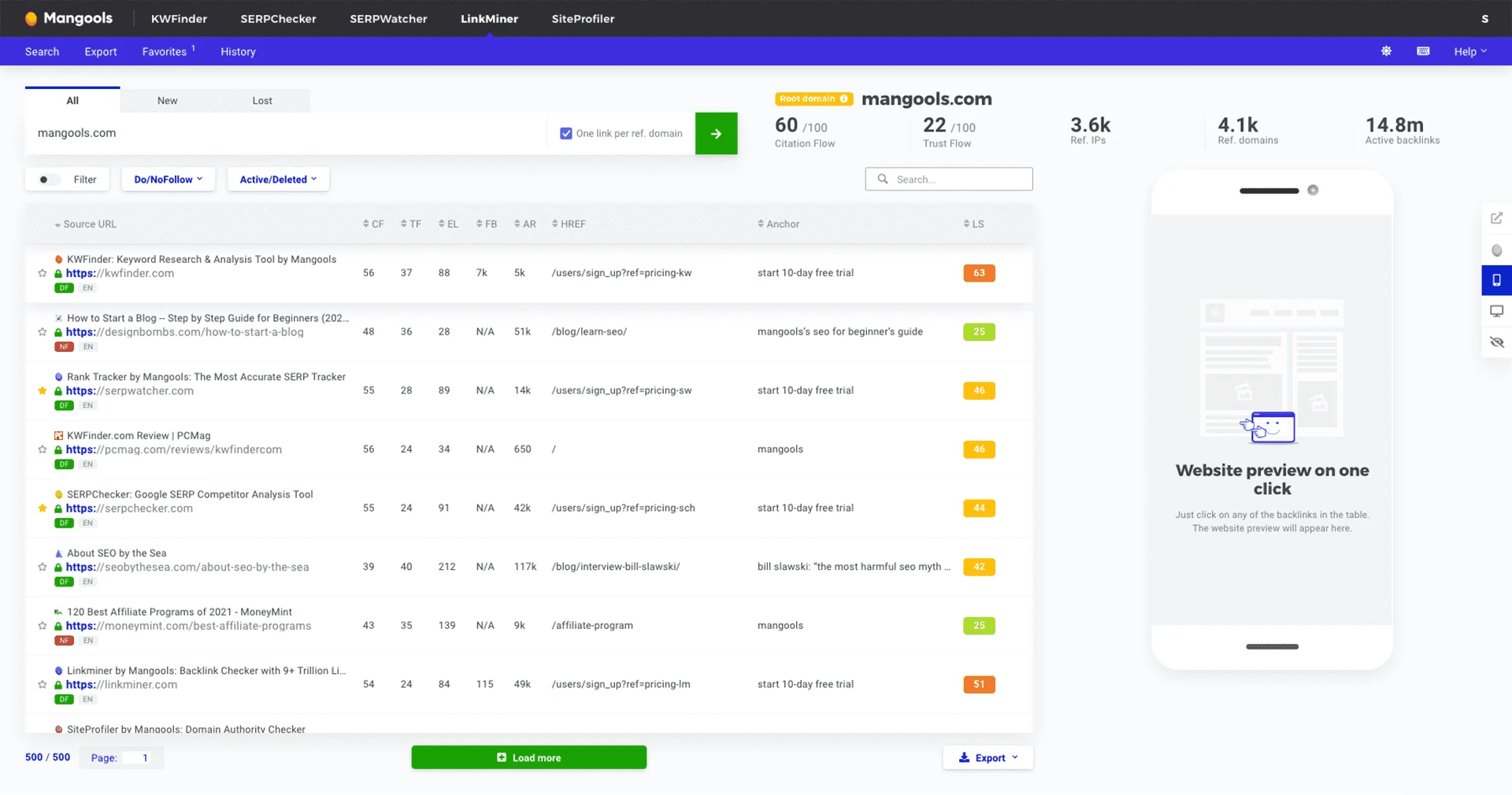
The standout feature is the live website preview. When you click on any backlink, LinkMiner shows you the actual page where the link appears, highlighted right on the page. No opening dozens of tabs to verify whether a backlink actually exists and where it's placed. This saves a surprising amount of time when you're auditing competitor link profiles or prospecting for link building opportunities.
On the Basic plan you get 100,000 backlink rows per month. Premium gives you 500,000, and Agency goes up to 1.2 million. For most small businesses and bloggers, 100K rows is sufficient. If you're doing competitive analysis on high authority domains with thousands of backlinks, you'll burn through that faster.
One honest note: LinkMiner's data comes from Majestic's index, which is excellent for link metrics but not as comprehensive as Ahrefs' proprietary crawler for discovering new links quickly. If backlink analysis is your primary use case, Ahrefs is still the gold standard. But as part of the Mangools suite, LinkMiner is more than adequate for most users.
SiteProfiler: competitor insights
SiteProfiler gives you a quick overview of any website's SEO health. Enter a domain and you see Domain Authority, Page Authority, Citation Flow, Trust Flow, Website Popularity Rank, referring IPs, Facebook shares, and a backlink trend graph. You also get a breakdown of top content by social shares and a list of top referring domains.
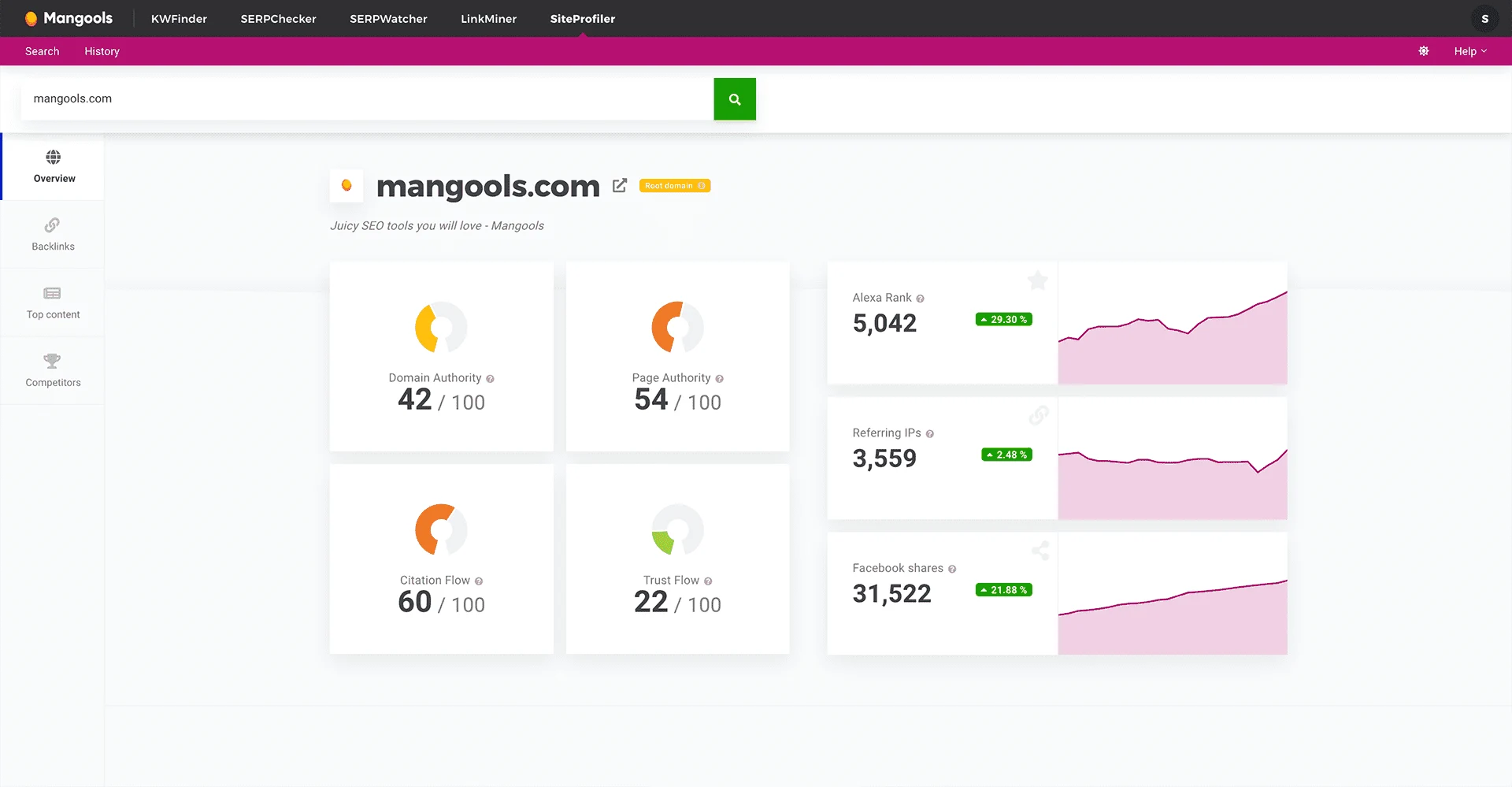
This is the least essential of the five tools, and some reviewers call it redundant since you can get similar data from LinkMiner and KWFinder. That's partially true. But SiteProfiler's value is in speed. When you want to quickly evaluate whether a competitor is worth analyzing deeper or whether a potential link partner has real authority, SiteProfiler gives you the answer in 5 seconds without running a full backlink analysis.
The top content feature is underrated. It shows you which pages on a competitor's site get the most social engagement. If you're brainstorming content ideas, seeing what's already proven to resonate in your niche saves time compared to guessing.
Want to test all five tools yourself? Mangools offers a free plan with no credit card required, plus a 10 day Free+ trial with higher limits.
Try Mangools FreeAI Search Watcher: the 2026 game changer
This is the feature that most Mangools reviews haven't caught up with yet. AI Search Watcher launched in late 2024 and has been expanding rapidly through 2025 and 2026. It monitors how your brand appears across AI powered search engines, including ChatGPT, Google Gemini, Claude, Grok, Llama, and Mistral.
Here's why this matters. When someone asks ChatGPT "what's the best SEO tool for beginners," the answer it gives could send thousands of people toward or away from your brand. Traditional rank trackers only monitor Google's organic results. AI Search Watcher tracks the other half of the equation that's becoming more important by the month.
The tool tracks three key metrics: Visibility (how often your brand appears in AI generated answers), Average Ranking (your typical position when you do appear), and AI Search Score (a combined 0 to 100 metric weighted by each AI model's market share). You can set up custom prompts to monitor, or use Mangools' suggested prompts based on your industry.
AI Search Watcher is sold separately starting at $15.60/month on an annual plan. But Mangools now offers bundle pricing that includes AI Search Watcher PRO with the SEO suite at roughly 50% off the standalone price. For example, the Basic bundle costs $37.70/month annually and includes 500 monitored prompts with unlimited monitors across all supported LLMs.
Mangools also released a free AI Search Grader tool that gives you a one time snapshot of your brand's AI visibility across three models without needing an account. It's a smart way to see whether AI search monitoring matters for your business before committing to the paid version.
Free mini tools you didn't know about
Beyond the five core tools and AI Search Watcher, Mangools offers a collection of free SEO tools that you can use without paying anything. Most Mangools reviews skip these entirely, but some of them are genuinely useful.
SERP Simulator lets you preview how your title tag and meta description will look in Google search results. You can drag your simulated snippet to any ranking position, toggle mobile versus desktop views, add rating stars, and even simulate AI Overviews and ads above your result. It's the best free SERP preview tool we've used.
Reddit Threads Finder identifies keywords where Reddit threads rank in the top search results. Since Google's 2024 partnership with Reddit boosted forum visibility dramatically, knowing which keywords have Reddit threads in the top 10 is valuable. You can find threads with few comments and jump in with genuine expertise, or identify topics where your content can outrank thin Reddit discussions.
SEO Content Optimizer connects to your Google Search Console data and gives you actionable recommendations to improve your existing content's rankings. It's free forever with a Mangools account.
AI Search Grader gives you a free snapshot of how any brand performs across AI search engines. Enter a brand name and niche description, and it tests prompts across ChatGPT, Mistral, and Llama to show your visibility and ranking performance.
Other free tools include Share of Search (compare brand popularity in Google), SERP Location Changer (check local SERPs in 65K+ locations), SERP Volatility Checker (monitor algorithm update impact), and a SEO Browser Extension for Chrome and Firefox that shows key metrics directly in your browser.
Mangools pricing in 2026: what you'll actually pay
Mangools keeps pricing straightforward. Three paid plans, all with the same five core tools. The only differences are usage limits and team seats. Annual billing saves you about 35% compared to monthly.
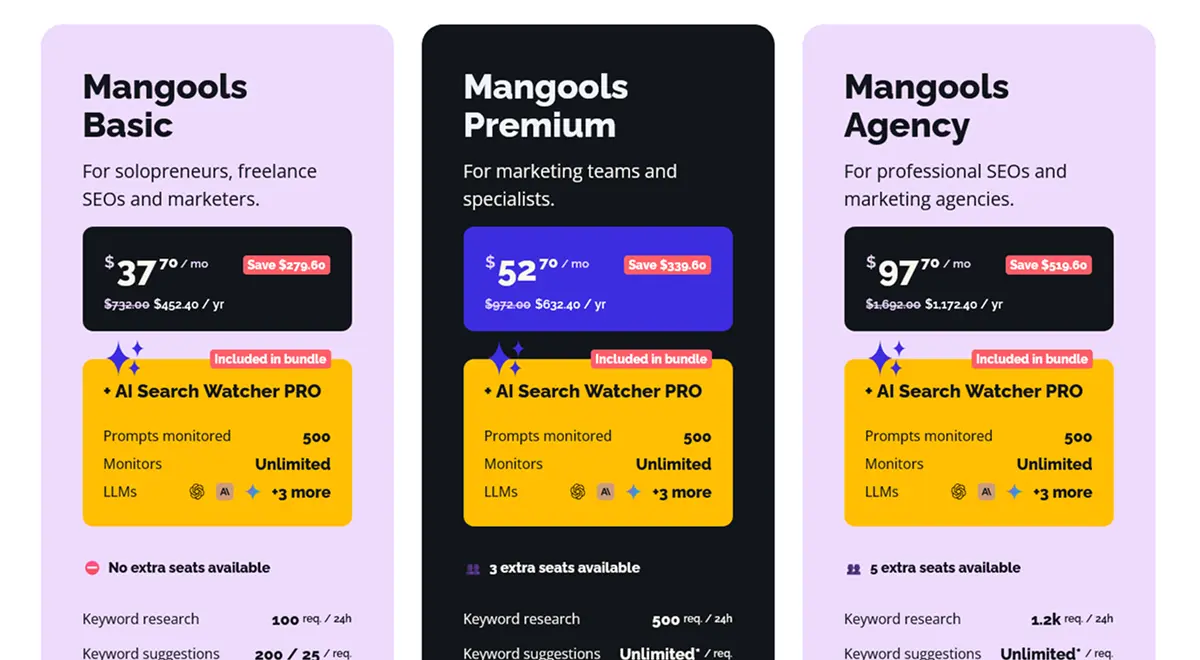
The Basic plan at $29.90/month (annual) gives you 100 keyword lookups per day, 200 keyword suggestions per search, 100 SERP lookups per day, 200 tracked keywords across unlimited domains, 100K backlink rows per month, and 20 site lookups per day. No extra seats available. This is the right plan for solo bloggers and freelancers. You can run daily keyword research, track your rankings, and analyze competitor backlinks without hitting the limits on most days. Monthly billing is $49.
The Premium plan at $44.90/month (annual) bumps everything up: 500 keyword lookups, unlimited suggestions, 500 SERP lookups, 700 tracked keywords, 500K backlink rows, and 70 site lookups. You also get 3 extra seats available at $19/month each. This is the sweet spot for small teams and active marketers who run research sessions daily. Monthly billing is $69.
The Agency plan at $89.90/month (annual) is the full package: 1,200 keyword lookups, unlimited suggestions, 1,200 SERP lookups, 1,500 tracked keywords, 1.2M backlink rows, and 150 site lookups. It comes with 5 extra seats at $12/month each. Even at the top tier, Mangools costs less than Semrush's entry level Pro plan at $139.95/month. Monthly billing is $129.
Mangools now also offers bundle pricing that includes AI Search Watcher PRO with every plan. The Basic bundle runs $37.70/month, Premium bundle $52.70/month, and Agency bundle $97.70/month, all on annual billing. Each bundle adds 500 monitored prompts with unlimited monitors across all supported AI search engines. If you care about AI search visibility (and you should), the bundle is a significantly better deal than buying AI Search Watcher separately.
All paid plans come with a 48 hour money back guarantee. Not 30 days like some competitors, but enough to confirm the tools work for your use case.
"At $29/month you really can't go wrong with a Mangools subscription. Great value."
— Brian Dean, BacklinkoThe free plan and trial: what you actually get
Unlike Ahrefs and Semrush (which have no free plans), Mangools offers a permanent free plan that never expires. You don't need a credit card to sign up, and it gives you genuine access to all five tools with daily limits.
What you get on the free plan: 5 keyword lookups per day in KWFinder with 15 related keywords and 5 competitor keywords per lookup. 5 SERP lookups in SERPChecker. 10 tracked keywords in SERPWatcher. 500 backlink rows per day in LinkMiner. And 5 site lookups in SiteProfiler. You also get access to all the free mini tools without any limits.
The 10 day Free+ trial unlocks temporarily elevated limits across all tools. It's designed to give you a realistic taste of what the paid experience feels like, without committing money. No credit card required.
Where it stops: The free plan limits are tight enough that you can't run serious research sessions. 5 keyword lookups per day with 15 suggestions each means you'll see about 75 keyword ideas total. That's enough to evaluate whether the tool fits your workflow, but not enough to do productive work consistently. If you're comparing SEO tools, the free plan lets you test Mangools alongside Ahrefs' free tier and Ubersuggest's free searches before deciding where to put your money.
What real users are saying
We went through reviews across Trustpilot, G2, Capterra, and Reddit to get the full picture of what users experience with Mangools after the honeymoon phase wears off.
Mangools holds a 4.9 out of 5 on Trustpilot (153 reviews, 94% five stars), 4.7 out of 5 on G2 (80+ reviews), and 4.8 out of 5 on Capterra (80+ reviews). Those are exceptional scores for any SaaS product. The most consistently praised aspects are the clean interface, the accuracy of keyword difficulty scores, the value for money, and the responsive customer support team (which is actually staffed by people who do SEO, not generic support agents).
On Reddit's r/SEO and r/JoanMarketing, the conversation is generally positive with fair criticism. Users frequently praise KWFinder as the most intuitive keyword research tool they've used. Multiple marketers who use both Mangools and Ahrefs describe keeping Mangools specifically for quick keyword checks because the interface is faster and less cluttered. The support team gets mentioned a lot too. Several users note that the chat support responds quickly and the agents actually understand SEO concepts rather than reading from scripts.
The most common complaints center on three things: the daily usage limits on cheaper plans (especially the 100 keyword lookups on Basic, which power users can exhaust in a heavy research day), the smaller keyword database compared to Ahrefs and Semrush (2.5 billion versus 21 to 25 billion keywords, meaning you might miss niche long tail terms), and the missing site audit tool which forces you to use a separate product for technical SEO checks.
One pattern we noticed: users who've tried multiple SEO tools almost always describe Mangools as the best starting point. Even reviews that ultimately recommend upgrading to Ahrefs or Semrush for advanced needs acknowledge that Mangools delivers the best value per dollar in the market.
Honest pros and cons breakdown
What we like
What could be better
Who should use Mangools (and who shouldn't)
Mangools is a strong fit if you are a blogger, content creator, or affiliate marketer who needs reliable keyword research and rank tracking without paying hundreds per month. It's also ideal if you're a freelancer or small agency managing a few client sites and need a tool that's fast to learn and easy to share reports from. If you've been using free tools like Google Keyword Planner and Ubersuggest and you're ready for something more accurate, Mangools is the natural upgrade.
You might prefer a different tool if you need technical site auditing as part of your SEO workflow (Ahrefs or Semrush), run a large ecommerce site that needs deep crawl data and content gap analysis at scale (Ahrefs), need data from search engines beyond Google (Semrush), or manage an enterprise level SEO operation with dozens of team members and complex reporting requirements.
"It's got a seamless interface, powerful features, and beautiful design, which makes it a great choice especially for beginner bloggers."
— Gael Breton, AuthorityHackerHow Mangools stacks up against the competition
There are several strong SEO platforms in 2026. Here's how Mangools compares to the alternatives you're most likely considering.
Mangools vs Ahrefs: This is the comparison most people want. Ahrefs is more powerful in almost every category: larger keyword database (21B vs 2.5B), deeper backlink analysis with a proprietary crawler, site audit tools, content explorer, and keyword gap analysis. But Ahrefs costs $99/month on its cheapest plan (Lite), which limits you to 500 credits per month with no rollover. One credit per keyword lookup means you burn through that in a single research session. Mangools gives you 100 lookups per day, every day, for $29.90/month. For most bloggers and small businesses, Mangools covers what you actually need at a third of the price. We have a full Mangools vs SE Ranking comparison if you want to see how it stacks up against another popular alternative.
Mangools vs Semrush: Semrush is the Swiss Army knife of SEO tools. It does everything: keyword research, site auditing, content marketing, social media tracking, PPC analysis, and more. The Pro plan costs $139.95/month, roughly five times what Mangools Basic costs. If you're a one person operation or a small team focused on organic search, you'll never use most of what Semrush offers. Mangools does the core SEO tasks (keyword research, rank tracking, backlink analysis) at a fraction of the cost with a much gentler learning curve. But if you need an all in one marketing platform, Semrush is hard to beat.
Mangools vs SE Ranking: SE Ranking is the closest competitor in terms of pricing and positioning. Their Essential plan starts at $44/month and includes site auditing, which Mangools lacks. SE Ranking also has a larger feature set overall. But KWFinder's interface and keyword difficulty accuracy are considered superior by most users who've tried both. If the missing site audit in Mangools is a dealbreaker, SE Ranking is the most logical alternative.
Mangools vs Ubersuggest: Ubersuggest by Neil Patel offers a lifetime plan for $290 (one time payment), which looks attractive. But the data quality and keyword database are significantly smaller than Mangools. Ubersuggest's keyword difficulty scores are less reliable, the interface is cluttered with upsells, and the rank tracking updates less frequently. Mangools is more expensive over time but delivers noticeably better data accuracy.
Frequently asked questions
Mangools has three paid plans when billed annually. Basic costs $29.90/month and gives you 100 keyword lookups per day, 200 tracked keywords, and 100K backlink rows monthly. Premium costs $44.90/month with 500 lookups, 700 tracked keywords, and 500K backlink rows. Agency costs $89.90/month with 1,200 lookups, 1,500 tracked keywords, and 1.2M backlink rows. Monthly billing is $49, $69, and $129 respectively. Mangools also offers bundle pricing with AI Search Watcher PRO starting at $37.70/month on the annual plan.
Yes, Mangools is one of the most beginner friendly SEO tools in 2026. The interface is clean and intuitive enough that you can start finding keywords and checking rankings within minutes of signing up. It scores 9.7 out of 10 for ease of use on G2, higher than any major competitor. The color coded keyword difficulty scores make it immediately obvious which keywords you can realistically rank for. The free plan lets you test everything before paying, and the Basic plan at $29.90/month covers everything a new blogger or small business needs.
Yes, Mangools offers a permanent free plan with limited daily usage. You get 5 keyword lookups in KWFinder, 5 SERP lookups in SERPChecker, 10 tracked keywords in SERPWatcher, 500 backlink rows per day in LinkMiner, and 5 site lookups in SiteProfiler. No credit card is required to sign up. There is also a 10 day Free+ trial that temporarily unlocks higher limits so you can test the tools more thoroughly before deciding on a paid plan.
They serve different audiences. Mangools is significantly cheaper ($29.90/month vs $99/month) and has a much simpler interface that beginners can learn in minutes. Ahrefs has a substantially larger keyword database at 21 billion versus 2.5 billion, more advanced backlink analysis with its own proprietary crawler, site audit tools, and content explorer features that Mangools simply does not offer. For bloggers, freelancers, and small businesses focused on keyword research and rank tracking, Mangools delivers excellent value. For agencies and advanced SEO professionals who need deep competitive analysis and technical auditing capabilities, Ahrefs justifies the higher price.
AI Search Watcher is Mangools' newest tool that launched in 2024 and expanded throughout 2025 and 2026. It monitors how your brand appears across AI powered search engines including ChatGPT, Gemini, Claude, Grok, Llama, and Mistral. It tracks your visibility score, average ranking positions, and citations in AI generated answers. The standalone pricing starts at $15.60/month on annual billing, but you can bundle it with the full SEO suite at roughly 50% off. There is also a free AI Search Grader tool that gives you a one time visibility snapshot without needing an account.
No, Mangools does not include a site audit tool. This is its biggest missing feature compared to competitors like Ahrefs, Semrush, and SE Ranking, all of which offer automated crawling to find technical SEO issues like broken links, missing meta tags, and page speed problems. For technical auditing, you can use Google Search Console's coverage reports for free, or pair Mangools with a dedicated audit tool like Screaming Frog. Mangools focuses specifically on keyword research, SERP analysis, rank tracking, backlink analysis, and competitor insights.
Yes, you can cancel your Mangools subscription at any time. Monthly plans cancel at the end of the current billing period. Annual plans cancel at the end of the annual term. Mangools also offers a 48 hour money back guarantee on all paid plans, so you can get a full refund within 48 hours of purchase if the tools do not meet your expectations. The free plan is always available if you want to keep limited access after canceling.
Final verdict: is Mangools worth it in 2026?
Yes, Mangools is absolutely worth it for the right user. If keyword research, rank tracking, and basic competitive analysis represent 90% of your SEO workflow, Mangools handles those tasks more elegantly and affordably than any tool at any price point. The combination of an industry leading interface, accurate keyword difficulty data across 2.5 billion keywords and 65,000+ locations, daily rank tracking, and now AI search monitoring makes it the most complete budget SEO suite available in 2026.
The platform's biggest strength is how it removes barriers. You don't need to be an SEO expert to get value from Mangools. The color coded difficulty scores, clean dashboard, and intuitive workflow mean you can go from zero to productive keyword research in under 10 minutes. That accessibility isn't just nice for beginners. Even experienced marketers keep Mangools in their stack because it's faster for quick checks than loading up a more complex tool.
The biggest weaknesses are real but manageable. No site audit tool means you'll need Google Search Console or a dedicated crawler for technical SEO. The 2.5 billion keyword database is smaller than Ahrefs (21B) or Semrush (25.4B), so you might miss some ultra niche long tail terms. The daily caps on the Basic plan can feel restrictive on heavy research days. And Google only data means no insights from Bing, YouTube, or Amazon search. These are legitimate limitations, but none of them are dealbreakers for the audience Mangools is designed to serve.
If you've been relying on free tools and wondering whether paid SEO software is worth the investment, Mangools at $29.90/month is the lowest risk way to find out. Start with the free plan, run a few keyword searches, track your most important rankings, check your competitors' backlinks, and you'll know within a day whether Mangools fits how you work. For most bloggers, freelancers, and small businesses, it will.
Ready to upgrade your SEO game? Get access to KWFinder, SERPChecker, SERPWatcher, LinkMiner, and SiteProfiler. Plans start at $29.90/month with a permanent free plan available.
Create a FREE account