

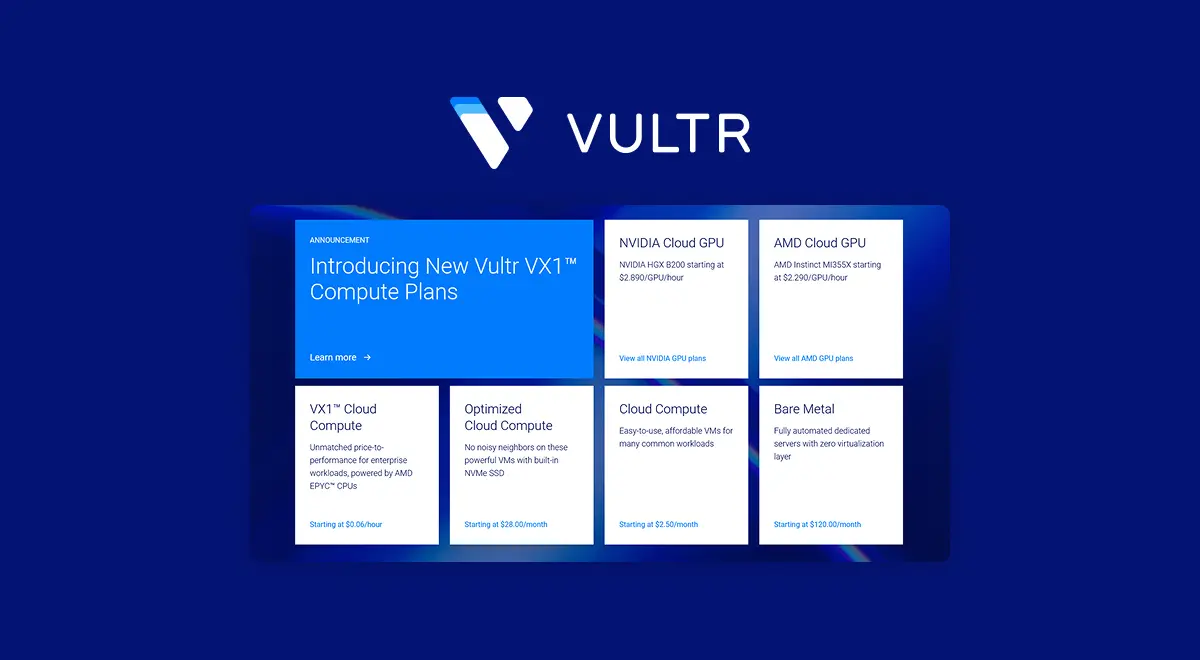
In October 2025, Vultr quietly launched VX1 Cloud Compute, and almost no one noticed. VX1 delivers up to 82% better performance per dollar than hyperscaler efficiency-optimized plans, which is the kind of claim that usually earns a raised eyebrow from anyone who's priced AWS lately. Only this time, the benchmarks back it up. Most Vultr reviews sitting on page one of Google right now were written before VX1 existed. That's why this review matters in 2026.
So here's the honest question: after 12 years, 32 datacenters, and the new VX1 launch, does Vultr actually deserve your cloud budget over DigitalOcean, Hetzner, or the big three? Let's look at what the numbers say.
Get $300 free credit on VultrWhat is Vultr and what's new in 2026?
Vultr launched in 2014, founded by David Aninowsky, and has grown into one of the largest independent cloud platforms in the world. The company is fully bootstrapped, has never raised equity financing, and now serves over 1.5 million customers across 185 countries with more than 80 million instances deployed. That's rare for a cloud provider in 2026, when most have sold to PE firms or gone public.
The 2026 headline is VX1 Cloud Compute, launched October 2025. VX1 is Vultr's answer to the hyperscalers and it's a real answer. The plans run on the latest AMD EPYC processors, deliver up to 82% better performance per dollar compared to hyperscaler cost-efficiency compute, support faster networking up to 50 Gbps, provision in under 15 seconds, and are 48% more energy-efficient than Vultr's own Optimized Cloud Compute plans. VX1 is also the only Vultr product that bills on actual hours used (not capped at 672/month like the rest).
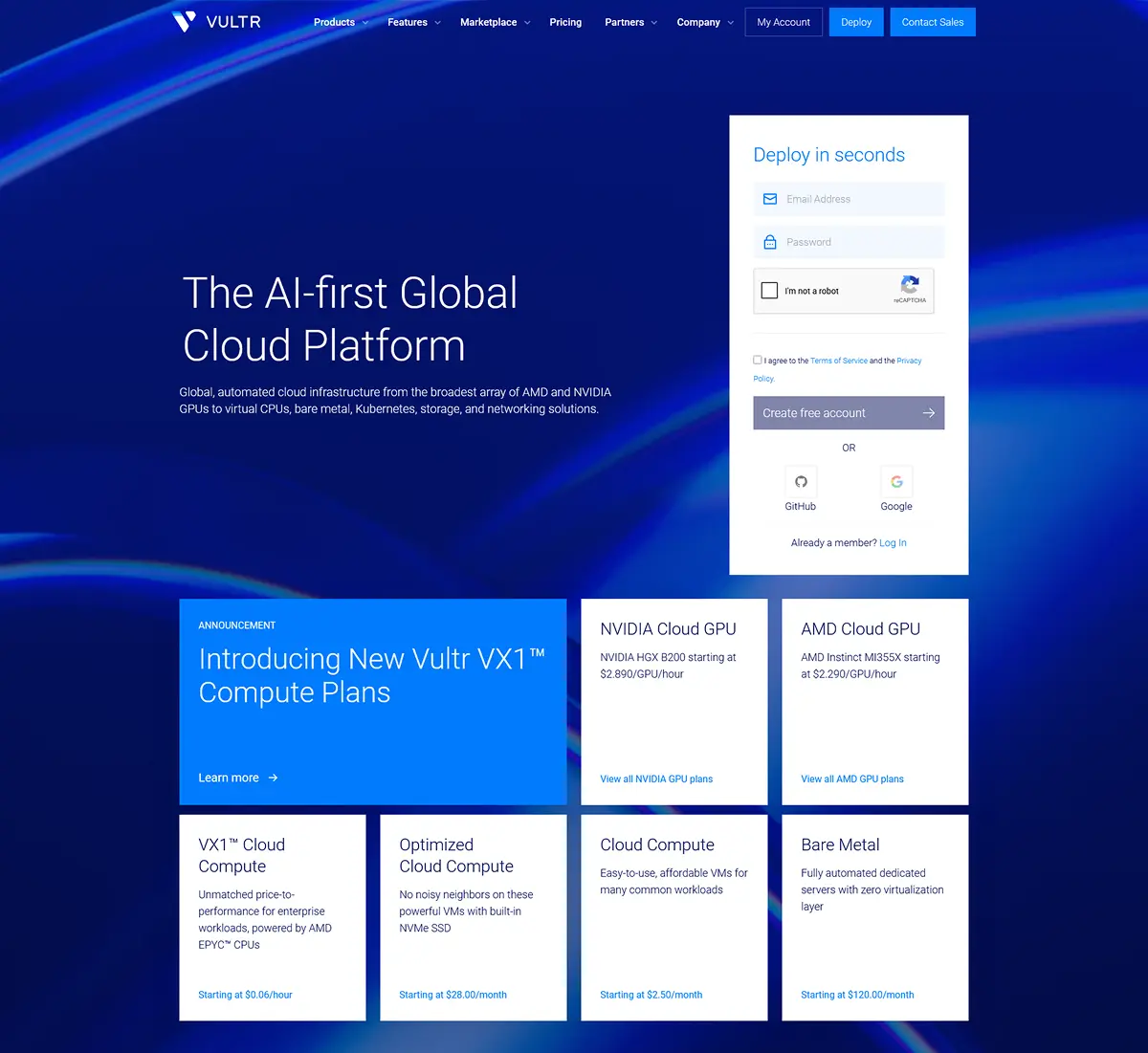
Beyond VX1, the infrastructure stayed strong through 2025 into 2026. Vultr operates 32 datacenter locations across 6 continents (19 countries), including a new Milan location opened March 2026. The company secured $329 million in credit financing in June 2025 to expand AI and GPU capacity, which is why you now see NVIDIA HGX B200, AMD MI355X, and new preemptible GPU options that launched December 2025.
The tech stack is everything a modern cloud should be: NVMe SSD storage across most plans, IPv6 support, full REST API, built-in monitoring charts for CPU, disk I/O, and network, and a 100% uptime SLA with credit-backed compensation covering both network and host availability. Compare that to DigitalOcean's 99.99% SLA and the difference shows up in production.
Who is Vultr built for?
Vultr works best for developers, DevOps engineers, startups, and small-to-mid engineering teams who want flexible cloud infrastructure without hyperscaler pricing. If you can SSH into a server and you know what Docker is, Vultr is priced for you. If you need fully managed hosting with hand-holding, this isn't the right tool.
Solo developers and indie hackers are the obvious fit at the low end. A 1 vCPU, 1GB RAM NVMe instance on High Performance runs $6/month. That's enough for a Node.js API, a staging WordPress, or a Docker host running side experiments. Add $5/month for IPv6-only on Cloud Compute Regular and you're at $2.50/month for hobby projects.
Startup engineering teams building production infrastructure land on Optimized Cloud Compute or VX1. Dedicated vCPUs starting at $28/month or $43.80/month give you consistent performance without noisy-neighbor risk. If you're scaling past a single box, Vultr Kubernetes Engine (VKE) handles orchestration for you. For heavier managed hosting needs, our Kinsta review covers the premium managed WordPress option.
AI and ML teams are a new audience for Vultr in 2026. The Cloud GPU lineup now includes NVIDIA HGX B200, H100, L40S, A100, and AMD MI355X preemptible instances. Athos, a precision therapeutics company working on autoimmune diseases and cancer research, runs its AI workloads on Vultr Cloud GPU. That's the scale this platform now supports.
Vultr is not the right pick for game servers, non-technical small business owners, or managed WordPress with phone support. No cPanel, no game-server optimizations. For simpler hosting needs, our FastComet review covers a cPanel-based option at lower cost.
The features that actually matter
Vultr has a long feature list. Most cloud providers do. Here are the features that actually matter for day-to-day infrastructure work and what they're really worth.
32 datacenter locations across 6 continents
This is Vultr's single biggest competitive advantage. You get 32 datacenters across 19 countries: 11 in North America, 7 in Europe (including the new Milan location), 7 in Asia-Pacific, plus locations in South America, Africa, and Oceania. DigitalOcean has 15 datacenters. Linode/Akamai has about 30 but some are newer with less mature networking. Hetzner Cloud has 6. If your users are in Mumbai, Johannesburg, São Paulo, or Warsaw, Vultr lets you deploy close to them at the same price as US East. That matters.
VX1 Cloud Compute (launched October 2025)
VX1 is the real story in 2026. Powered by the latest AMD EPYC processors, VX1 delivers up to 82% better performance per dollar than hyperscaler efficiency-optimized compute plans. You also get faster networking up to 50 Gbps, dedicated CPU resources, instant provisioning, 48% better energy efficiency than Vultr Optimized Cloud Compute, and actual-hours billing instead of the 672-hour cap. Starting at $43.80/month for 2 vCPU, 8GB RAM, 50GB storage. For production workloads, this is the tier to watch.
100% uptime SLA with credit-backed compensation
Most cloud providers promise 99.99% uptime. That's 52 minutes of downtime per year allowed before they owe you anything. Vultr guarantees 100% covering both network availability and host node availability, with credit compensation when they miss. In real-world usage, developers consistently report uptime well above 99.95% across multiple datacenters. The SLA isn't marketing fluff here.
Fast provisioning and clean API
Vultr provisions instances in 90 seconds on average (median 90s, fastest 30s, slowest 260s based on independent testing of 11 deployments). The REST API is comprehensive and well-documented, supporting full infrastructure-as-code workflows through Terraform, Pulumi, or direct curl calls. For teams building CI/CD pipelines that spin up staging environments, this matters.
New Vultr accounts get $300 in free credit when you link a valid payment method. That's enough to run a mid-tier VX1 instance for over 6 months, or test deployments across multiple datacenter locations, or spin up a GPU instance for an AI experiment.
Claim your $300 Vultr creditVultr pricing in 2026: the full breakdown
Vultr's pricing is transparent and hourly-billed across every product. Here's what you'll actually pay across the full product lineup in 2026.
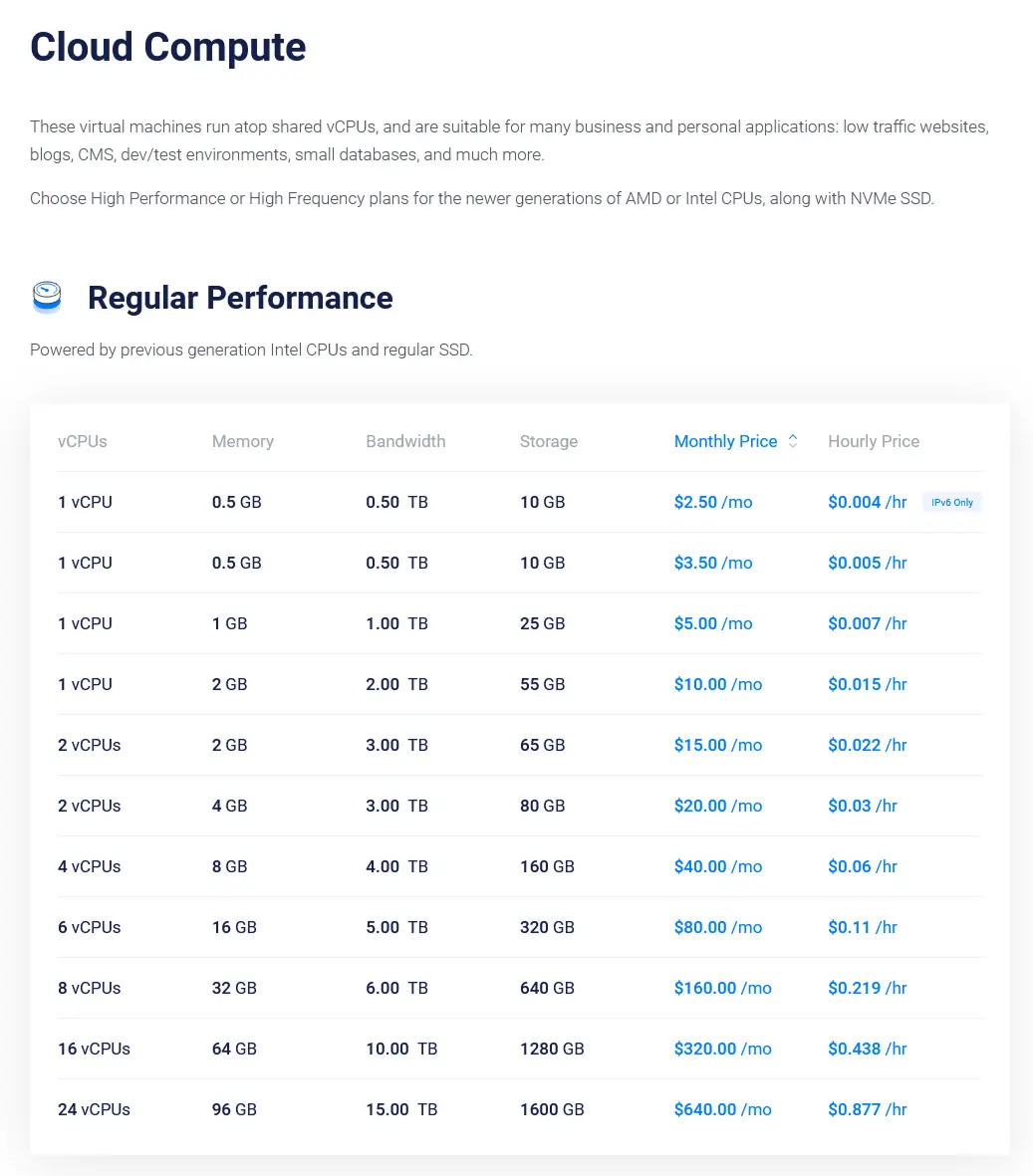
The Cloud Compute Regular tier starts at $2.50/month for 1 vCPU, 512MB RAM, IPv6-only. Only available in Atlanta, limited to 2 instances per account, so treat it as a hobby tier. The IPv4 version starts at $5/month for 1 vCPU, 1GB RAM, 25GB storage. Runs on previous-generation Intel CPUs with regular SSD.
High Performance Cloud Compute starts at $6/month for 1 vCPU, 1GB RAM, 25GB NVMe. Powered by newer AMD EPYC or Intel Xeon CPUs. Most developers start here. The 2 vCPU, 4GB, 100GB plan at $24/month is the sweet spot for a small production app.
High Frequency Cloud Compute also starts at $6/month, powered by 3GHz+ Intel Xeon CPUs and NVMe. Same price as High Performance but better single-thread performance, which matters for databases.
Optimized Cloud Compute starts at $28/month for 1 vCPU, 2GB RAM, 25GB NVMe, dedicated vCPUs. Four sub-tiers: General Purpose, CPU Optimized, Memory Optimized, Storage Optimized. Production apps live here.
VX1 Cloud Compute starts at $43.80/month for 2 vCPU, 8GB RAM, 50GB storage. Up to 82% better performance per dollar than hyperscaler efficiency plans. Worth every dollar over Optimized if your workload has real CPU needs.
Bare Metal starts at $120/month for Intel E3-1270 (4 cores, 32GB RAM). Top-end AMD EPYC 7713 runs $8,185/month. Single-tenant dedicated hardware for when virtualization overhead matters.
Cloud GPU pricing starts at $0.471/hour for an NVIDIA A16. Top-tier NVIDIA HGX B200 runs $2,990/GPU/hour for AI training. AMD MI355X preemptible starts at $2,650/GPU/hour. Genuinely competitive with AWS and Azure on-demand rates.
A few pricing details worth knowing. Bandwidth overage varies by region: $0.01/GB in North America and Europe, $0.05/GB in Tokyo, $0.10/GB in Australia. No bandwidth pooling across instances. Automatic backups cost 20% of instance price. DDoS protection is $10/month up to 10 Gbps, not included by default.
"Integrating Vultr into Cycle's platform was simpler than expected and straight-forward compared to most providers. It was clear we were working with APIs built with the developer in mind."
— Jake Warner, CEO at Cycle.ioPerformance and reliability: the real numbers
Every cloud provider claims "blazing fast" and "enterprise-grade." Here's what independent benchmarks actually show for Vultr in 2026.
On provisioning speed, Vultr averages 90 seconds from order to SSH-ready across 11 independent VPSBenchmarks trials (min 30s, max 260s). Faster than DigitalOcean and significantly faster than AWS EC2.
On uptime, the 100% SLA is backed up in practice. Most developers running production workloads report 99.98%+ real-world uptime. Vultr has won multiple VPSBenchmarks "Best VPS" awards across price tiers from 2020 through 2024.
On disk I/O, the High Frequency tier shows a measured 92% improvement in random read IOPS over Regular in independent testing. That's the NVMe vs SATA gap, and it translates directly into faster MySQL queries and quicker page loads. If you're picking between Regular and High Frequency, spend the extra dollars.
On network, VX1 supports up to 50 Gbps vs 10-25 Gbps on other tiers. The global network uses 12,000 Mbps public capacity and connects through 200 CDN access points. For global audiences, this matters more than raw single-datacenter performance.
The honest weakness is CPU throttling. If a shared-tier instance hits 100% CPU for extended periods, Vultr throttles it to minimum performance, sometimes for 48 hours or more. This catches developers off guard on Regular and High Performance tiers. The fix is either upgrading to Optimized or VX1 (both use dedicated vCPUs), or accepting that shared compute means shared compute.
What real users are saying in 2026
We went through recent reviews on G2, TrustRadius, Reddit, and Trustpilot to see what actual Vultr customers think in 2026.
The consistent praise goes to global datacenter coverage, transparent pricing, fast provisioning, clean control panel, and responsive documentation. Multiple G2 reviewers specifically mention bare metal deployment in 5 minutes and responsive support for technical tickets. Developers call out the REST API quality consistently.
Production teams running WordPress, Mautic, Minecraft servers, VPN endpoints, IoT backends, and WooCommerce stores all report moving to Vultr for cost efficiency. One G2 reviewer moved a WooCommerce store from Microsoft Azure to Vultr with significantly better cost efficiency.
Common complaints are predictable. CPU throttling comes up in Trustpilot and G2 reviews repeatedly, especially from users running video encoding or high-traffic sites on shared tiers. A few reviewers mention account verification delays during anti-fraud checks, and others mention bandwidth overage costs in Australia and Tokyo being higher than expected.
"Athos is committed to providing novel precision therapeutics for patients with autoimmune diseases and cancer. The combination of Vultr Cloud GPU, accelerated by NVIDIA, and Dell infrastructure enables us to achieve our aims. Our AI computational teams are excited about collaborating with Vultr."
— Dimitrios Iliopoulos, PhD MBA, President and CEO at AthosHonest pros and cons breakdown
So is Vultr good across the board or are there real trade-offs? Here's the straight take after reviewing pricing, features, user feedback, and independent benchmark data.
What we like
What could be better
Who should use Vultr (and who shouldn't)
Vultr is a strong choice if you're a developer or DevOps engineer comfortable with SSH and Linux, need a cloud provider with genuine global reach (non-US audiences especially), want hourly billing and pay-per-use pricing, build infrastructure with Terraform or direct API calls, run AI/ML workloads that need NVIDIA or AMD GPU access, or specifically need VX1's hyperscaler-beating price-to-performance ratio.
Skip Vultr if you need fully managed WordPress hosting with cPanel and phone support, run game servers that need DDoS protection and game-specific optimizations, prioritize European-data-center pricing (Hetzner is cheaper for EU-only workloads), or want a managed database experience more polished than Vultr's current offering. For those use cases, our Kinsta review covers premium managed WordPress, and our FastComet review covers cPanel-based shared hosting at lower cost.
How Vultr stacks up against the competition
Vultr competes in the developer cloud space against DigitalOcean, Akamai Cloud (formerly Linode), Hetzner, and the big three hyperscalers. Here's the honest comparison.
Vultr vs DigitalOcean. Both target developers with similar pricing and feature overlap. Vultr wins on datacenter count (32 vs 15), uptime SLA (100% vs 99.99%), and VX1's price-to-performance. DigitalOcean wins on documentation quality, managed database polish, and community tutorials. For global audiences and raw compute value, Vultr. For smoother managed services, DigitalOcean.
Vultr vs Akamai Cloud (Linode). After Akamai acquired Linode, pricing stayed similar but product direction shifted toward edge and CDN. Vultr has broader datacenter coverage and faster provisioning. Linode has bandwidth pooling (useful for multi-server setups) and Akamai's CDN integration. For independent cloud with strong core compute, Vultr. For edge-integrated infrastructure, Akamai Cloud.
Vultr vs Hetzner. This is the brutal one. Hetzner's EU pricing is significantly cheaper: a comparable 2 vCPU, 4GB instance runs about €6-8/month on Hetzner vs $24/month on Vultr High Frequency. For European-only workloads, Hetzner wins on pure price. Vultr wins on datacenter reach (32 vs 6), the 100% SLA, VX1's performance-per-dollar, and non-EU availability. For EU budget workloads, Hetzner. For global reach, Vultr.
Vultr vs AWS/Azure/GCP. Vultr is significantly cheaper for equivalent compute and VX1 specifically targets this gap with up to 82% better performance per dollar. What you lose is the deep managed services ecosystem (Lambda, RDS, CloudFront, IAM complexity). If your architecture is pure compute, storage, and a few managed databases, Vultr saves you 60-80% with minimal feature loss. If your architecture relies on 15 AWS services, Vultr isn't a drop-in replacement.
How to get started the smart way
Signing up for Vultr is fast, but a few moves separate a clean setup from one you'll regret in week three.
First, claim the $300 free credit at signup. Link a valid credit card or PayPal and the credit activates automatically. It lasts 30 days and covers any Vultr product. That's enough to run a mid-tier VX1 instance for 6 months or test 5-6 datacenter locations to see which delivers the best latency for your users.
Second, pick the right tier based on your workload. Hobby or dev work goes on Cloud Compute Regular or High Frequency ($2.50-$12/month). Small production apps belong on High Performance or High Frequency ($6-$48/month). Serious production goes on VX1 ($43.80+/month). AI/ML goes straight to Cloud GPU. Don't start on Regular if you plan to go production, the upgrade path costs you a migration.
Third, pick your datacenter based on where your users actually are. NA users: Atlanta, Dallas, LA, New York. EU users: Frankfurt, London, Milan, Paris. Asian traffic: Singapore, Tokyo, Mumbai. The "Available Services" indicator shows which products support each region before you commit.
Fourth, set up backups or roll your own. Vultr backups cost 20% of instance price and only keep two snapshots. If you're running anything with user data, either pay for backups or set up rsync/Restic to Object Storage ($0.006/GB/month). Don't skip this.
Fifth, enable monitoring from day one. Built-in charts cover CPU, disk I/O, network. For production, layer on Prometheus or Datadog so you catch CPU throttling before it becomes a 48-hour outage. If your instance hits 100% CPU regularly, that's the signal to move up a tier.
"Our industry is evolving rapidly, and we needed a cloud provider that could keep up."
— Frédéric Chabot, Head of Corporate Development at MindWalkFrequently asked questions
Vultr is good if you want a developer-first cloud provider with 32 global datacenters, transparent pricing from $2.50/month, and a 100% uptime SLA. It's bootstrapped, independent, and has served over 1.5 million customers across 185 countries. The new VX1 Cloud Compute line launched October 2025 delivers up to 82% better performance per dollar than hyperscaler efficiency plans, which is a genuine competitive edge. The trade-offs are real though. Vultr throttles CPU automatically when instances hit 100% for extended periods, bandwidth overage pricing varies wildly by region, and there's no bandwidth pooling across servers. For developers building on standard cloud infrastructure, Vultr is a strong pick. For hands-off managed hosting or game servers, it's not the right tool.
Vultr Cloud Compute starts at $2.50/month for a 1 vCPU, 512MB RAM IPv6-only instance, or $5/month for the same instance with IPv4. High Performance and High Frequency plans start at $6/month. Optimized Cloud Compute with dedicated vCPUs starts at $28/month. The new VX1 Cloud Compute line starts at $43.80/month for 2 vCPU, 8GB RAM. Bare Metal servers start at $120/month for an Intel E3-1270 setup. Cloud GPU starts at $0.471/hour for an NVIDIA A16. All pricing is hourly-billed and capped at 672 hours per month, except VX1 which bills on actual hours used.
VX1 is Vultr's newest cloud compute line, launched October 2025. It's powered by the latest generation of AMD EPYC processors and delivers up to 82% better performance per dollar compared to leading hyperscaler cost-efficiency plans. VX1 instances support booting from High Performance NVMe Block Storage, offer faster networking up to 50 Gbps, dedicated CPU resources, and instant provisioning in under 15 seconds. They're also 48% more energy-efficient than Vultr Optimized Cloud Compute plans. Unlike other Vultr plans capped at 672 hours/month, VX1 bills on actual hours used. Starting price is $43.80/month for 2 vCPU, 8GB RAM, 50GB storage.
Vultr's pros include 32 datacenter locations across 6 continents, transparent hourly pricing from $2.50/month, 100% uptime SLA with credit-backed compensation, fast provisioning in 90 seconds on average, clean modern control panel, comprehensive REST API, and a generous $300 free credit offer for new accounts. The cons are real too. Vultr automatically throttles CPU to minimum performance when instances hit 100% usage, sometimes for 48 hours or more. Bandwidth overage pricing varies dramatically by region, from $0.01/GB in North America up to $0.10/GB in Australia. There's no bandwidth pooling across instances. Backups cost extra at 20% of the instance price. DDoS protection is a paid add-on starting at $10/month.
Vultr and DigitalOcean both target developers with similar pricing, but they differ in meaningful ways. Vultr has 32 datacenter locations vs DigitalOcean's 15, making Vultr the better pick for global audiences or specific regional requirements. Vultr's 100% uptime SLA is stronger on paper than DigitalOcean's 99.99%. DigitalOcean has better documentation, more polished managed services, and a more refined control panel. Vultr's VX1 line is up to 82% better performance per dollar than hyperscaler compute plans, which beats DigitalOcean's Premium droplets on pure value. For global reach and raw compute value, Vultr wins. For documentation quality and managed database integration, DigitalOcean wins.
Vultr does not offer a traditional free trial, but new accounts get a $300 free credit when they link a valid credit card or PayPal method. The credit lasts 30 days, during which you can deploy and test any Vultr product including Cloud Compute, Cloud GPU, Bare Metal, and managed services. The credit is enough to run a mid-tier instance for a few weeks or test multiple datacenter locations. To qualify for the full credit referral program, the account needs to be active for 30+ days and use at least $100 in payments. There's no credit card requirement to sign up, but you'll need to add a payment method before deploying.
Final verdict: is Vultr worth it in 2026?
So, is Vultr worth it in 2026 after the VX1 launch? Yes, for the right use cases. Vultr sits in a genuinely competitive spot: developer-friendly pricing, global reach, fast provisioning, and now a product (VX1) that actually challenges hyperscaler compute on price-to-performance.
The platform's biggest strengths are the 32 datacenter footprint (unmatched in independent cloud), VX1's hyperscaler-beating price-to-performance (up to 82% better than AWS/Azure/GCP efficiency compute), and the bootstrapped independence that keeps the platform focused on compute fundamentals.
The biggest weaknesses are honest limitations. CPU throttling on shared tiers catches people off guard, regional bandwidth pricing can hit hard in Australia and Tokyo, and managed services feel a step behind DigitalOcean's polish. The workaround is upgrading to dedicated tiers (Optimized or VX1) and pricing bandwidth into your architecture.
If you've been considering it, the $300 free credit is the cleanest way to evaluate. Sign up, deploy a VX1 instance in your target datacenter, run your actual workload for two weeks. If VX1 delivers what the benchmarks claim, you've just found a production-ready cloud at 60-80% hyperscaler cost. If it doesn't fit, you walk away with zero dollars spent. For developers in 2026, Vultr earns its spot as one of the strongest independent cloud picks on the market.
Vultr offers 32 datacenter locations, hourly pricing from $2.50/month, and a $300 free credit for new accounts. The VX1 Cloud Compute line launched October 2025 delivers up to 82% better performance per dollar than hyperscaler efficiency-optimized plans, starting at $43.80/month. Cloud GPU starts at $0.471/hour for NVIDIA A16 instances scaling up to HGX B200 for AI training workloads.
Get $300 free Vultr credit