

Dynadot has been the quiet engineer of the domain world since 2002. Over 9 million domains managed, 100,000+ customers across 108 countries, 4.5 out of 5 from 4,460+ Trustpilot reviews. But the real question in 2026, with Spaceship undercutting on price and Namecheap bundling everything: is Dynadot still relevant? This review covers what they do well, what they don't, and whether their products deserve your money.
Visit DynadotWhat is Dynadot and what do they actually do?
Dynadot started in 2002 when founder Todd Han got fed up with how counterintuitive every other registrar was. Instead of switching providers, he built his own. Today the company is headquartered in San Mateo, California, manages over 9 million domain names for more than 100,000 customers globally, and is still privately held and debt-free.
The current lineup covers domain registration across 500+ TLDs, an aftermarket marketplace, expired auctions, backorders, brokerage, AI domain search, an AI website builder, custom email, SSL, and a domain reseller program. Some are genuinely strong. Others exist as conveniences for existing customers.
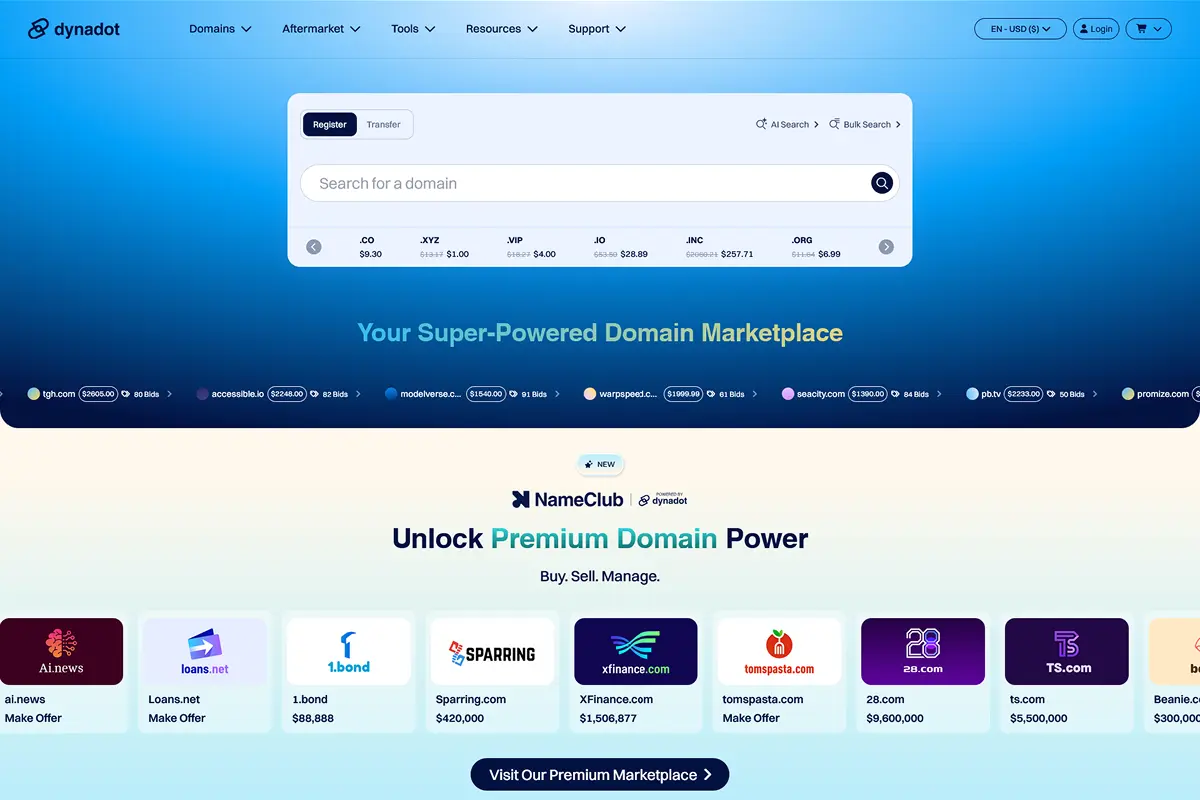
The two products most people care about are domain registration (consistently among the cheapest for renewals) and the aftermarket (now one of the top three marketplaces globally). The aftermarket includes user listings, expired auctions, backorders, and the new NameClub premium marketplace handling sales like ts.com at $5.5M and tb.com at $12.6M.
One thing genuinely sets Dynadot apart: they don't compete with their own customers. They don't maintain a Dynadot-owned portfolio to flip. Other registrars do. That alignment matters more than it sounds if you're building a portfolio.
Who is Dynadot built for?
Dynadot works best for domain investors, developers, and anyone who wants honest flat pricing without intro-rate games. The interface is clean, the pricing is on the homepage, and there's no upsell pressure at checkout. Building a portfolio, registering domains in bulk, or running automated workflows all work without nickel-and-diming.
Domain investors and resellers get the most value. Bulk searches up to 5,000/day on Superbulk, free domain appraisals, expired auctions, backorder tools, prioritized API calls, and a marketplace with over 6 million user listings. The Bulk tier kicks in at $500 spent annually and Superbulk at $5,000, both unlocking marketplace features competitors charge extra for.
On the other hand, Dynadot is probably not the right fit if you want bundled hosting, managed WordPress, or professional email at a discount. The website builder is fine for basic portfolio sites but isn't competing with Wix or Squarespace. Hosting and email exist but aren't the focus.
If you need a domain plus shared hosting plus business email all in one dashboard, Namecheap or Hostinger are stronger. Dynadot's sweet spot is purely domain-focused.
The features that actually matter
Dynadot's feature list is long. Here are the ones that actually matter day to day.
Honest flat pricing with free WHOIS privacy
This is Dynadot's strongest pitch. .com domains start at $10.88/year with the same price for registration, renewal, and transfer. No intro-rate trick that doubles in year two. Other prices: .xyz at $1.00, .org at $6.99, .co at $9.30, .io at $28.89, .net at $12.52. Every domain includes free WHOIS privacy for life on most TLDs, which competitors charge $10 to $15/year for.
500+ TLDs and automatic bulk pricing tiers
Dynadot supports over 500 domain extensions from the standards to country codes to the long tail (.ai, .io, .vip, .shop). Two spending tiers unlock perks automatically: Bulk at $500/year spent (100 daily appraisals, 2,000 bulk searches/day). Superbulk at $5,000/year (1,000 appraisals, 5,000 searches, dedicated account manager, prioritized API, exclusive marketplace features). No paperwork, no application.
The domain aftermarket and NameClub
Dynadot's aftermarket is one of the top three in the industry. User listings count over 6 million domains starting at $1, expired auctions run daily, and the backorder system grabs dropping domains automatically. The newer NameClub premium marketplace handles brokerage with names like 28.com at $9.6M, ts.com at $5.5M, and tb.com at $12.6M. Full breakdown below.
Domain reseller program and developer API
The reseller program gives you separate registrar accreditation (your customers don't see Dynadot underneath), full pricing control, WHMCS integration, and an exclusive account manager. The API supports automated registration and management at scale. Genuinely well built for agencies bundling domains into client packages.
AI tools and free extras
Dynadot's AI Domain Search generates name ideas from natural-language prompts. The AI Sitebuilder creates basic websites in minutes. Free Domain Appraisals give instant valuations. Every registration includes a free website builder, free custom email, and free privacy. Honest extras instead of paid add-ons.
Want to see Dynadot's tools yourself? Domain registration starts at $10.88 for .com with free privacy, the marketplace is free to browse, and there's no minimum commitment.
Try DynadotDynadot pricing in 2026: what you'll actually pay
Dynadot has multiple product lines but the pricing logic is consistent: flat rates, no intro-to-renewal jump on major TLDs, prices visible upfront. Here's what things actually cost in 2026.
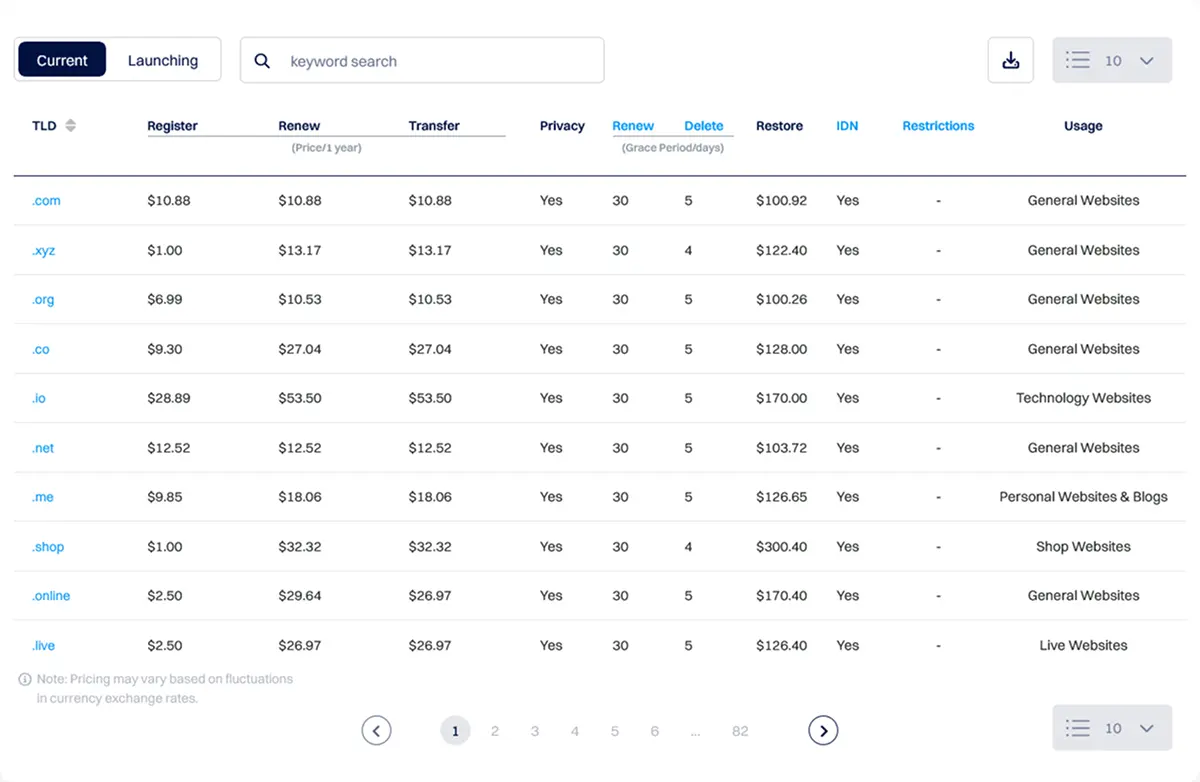
Domain registration starts at $10.88/year for .com, with the same flat rate for renewals and transfers. .xyz at $1.00/year intro (renews $13.17), .org $6.99 (renews $10.53), .co $9.30 (renews $27.04), .io $28.89 (renews $53.50), .net $12.52, .shop $1.00 intro (renews $32.32). Bulk discounts apply above $500/year spent.
The aftermarket pricing is straightforward. User-listed domains start at $1 with no commission to the buyer. NameClub premium ranges from $300,000 to $12.6M. Backorders run $24 to $69 per attempt. Selling fees on user-listed domains are 10% (5% on Superbulk).
Domain extras are honest. WHOIS privacy is free on most TLDs. DNS hosting is free. Email forwarding is free. SSL certificates start around $15/year. The reseller program is free to join with volume discounts at scale.
One thing to watch: some popular new TLDs have steep renewal jumps from registry pricing. .xyz at $1.00 renews at $13.17. .shop at $1.00 renews at $32.32. .co renews at $27.04. The flat-pricing pitch holds firm on .com, .net, .org, and most established extensions, but newer TLDs follow registry pricing. Read the renewal column before committing.
"Easy platform to use and support are super helpful and friendly."
— Nick Sullivan, Trustpilot review (April 2026)The aftermarket: where Dynadot quietly wins
Dynadot's aftermarket deserves its own section because it's where the platform genuinely outperforms competitors. It's a full domain trading ecosystem built into the registrar itself: user listings, expired auctions, backorders, brokerage, appraisals, and the premium NameClub marketplace, all under one account.
The standout feature is depth. The user marketplace lists over 6 million domains starting at $1. Filter by length, TLD, age, inbound links, and Dynadot's own appraisal score. Pending sales appear next to active listings, so you get a real sense of what's actually moving.
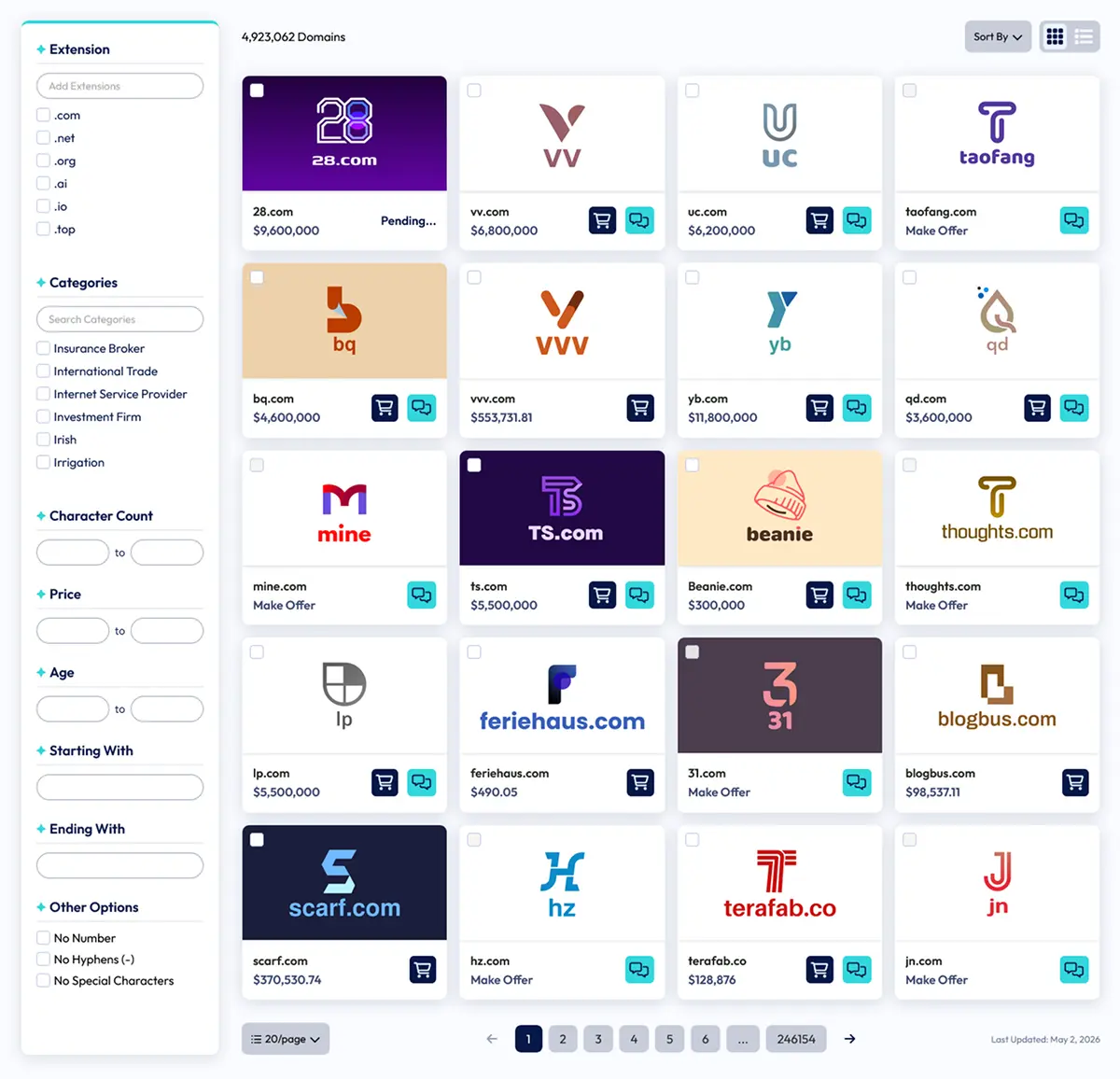
The NameClub premium marketplace launched in 2025 focuses on high-value sales from $100,000 to $12M+. Recent listings include b.ai at $8.6M, hotdeal.com at $100,000, Master.ai at $1.25M, and Travel.io with offers open. For investors at the high end, NameClub's curation matters because the listings are vetted and brokered by Dynadot's team.
The backorder system is also strong. Pay a small fee, Dynadot tries to grab a dropping domain the moment it becomes available. Combined with expired auctions, this is a serious tool for SEO-focused buyers chasing aged domains. The platform also acts as escrow for direct private sales between users. The free instant appraisal tool alone is more useful than what most paid services offer.
What real users are saying in 2026
We went through recent reviews on Trustpilot, G2, NamePros, and Reddit to see what current Dynadot customers actually think.
The platform holds 4.5 out of 5 across Trustpilot from 4,460+ verified reviews, which is genuinely strong for a domain registrar. The most consistent praise goes to support quality, transparent pricing, and the marketplace tools. Live chat is responsive 24/7 and the team actually solves problems.
One April 2026 reviewer said an agent named Arthur was "amazing" and helped them set up DNS in a non-standard configuration they "honestly couldn't have done" alone. Another described the platform as "easy to use" and the support as "super helpful and friendly." A first-time user said the information was "fast and precise." Dynadot's support culture is its hidden moat.
The common complaints are predictable. Some new TLDs have renewal jumps from registry pricing (Dynadot doesn't control these). A handful of G2 reviewers mention the interface looks dated compared to Spaceship. A few NamePros threads cite occasional database lag during peak auction times. Real but minor.
Honest pros and cons breakdown
Here's our straight take after reviewing pricing, features, marketplace depth, and recent user feedback.
What we like
What could be better
Who should use Dynadot (and who shouldn't)
Dynadot is a strong choice if you're a domain investor building or managing a portfolio, a developer who wants a clean API and bulk tools, a small business owner who values transparent renewal pricing over intro-rate gimmicks, or anyone who wants free WHOIS privacy without paying extra for it. The marketplace alone justifies an account if you trade or research domains regularly.
Skip Dynadot if you want bundled hosting and email under one roof, you need a polished modern dashboard, you're looking for managed WordPress with one-click setup, or you want the absolute cheapest first-year .com on the market. For those use cases, Namecheap, Hostinger, or Spaceship deliver better-fit options at a similar long-term cost.
How Dynadot stacks up against the competition
Dynadot vs Namecheap. Namecheap wins on bundled products (hosting, EasyWP, Private Email, SSL) and a more polished dashboard. Dynadot wins on flat domain pricing (no intro-to-renewal jump on .com), the marketplace, and free WHOIS privacy on more extensions. If you only care about domains and the aftermarket, Dynadot is better.
Dynadot vs GoDaddy. Dynadot is cheaper across nearly every product, charges no aggressive upsells, and includes free privacy. GoDaddy has more aggressive marketing and sometimes cheaper first-year promos, but renewal pricing and add-on pressure typically wipe out the savings. For honest long-term value, Dynadot wins.
Dynadot vs Spaceship. Spaceship (owned by Namecheap) has lower headline prices on .com and a more modern interface. Dynadot has a deeper marketplace, more developer tools, and 24 years of track record. For pure cheap registrations, Spaceship edges out. For everything else, Dynadot is more complete.
Dynadot vs Cloudflare. Cloudflare sells domains at registry cost (cheapest in the industry) but offers no aftermarket, no portfolio tools, no marketplace. For investors and resellers, Dynadot is dramatically more useful. For one-domain buyers focused only on price, Cloudflare wins.
How to get started without the headaches
Signing up for Dynadot is straightforward, but a few things are worth knowing upfront.
Start with the AI Domain Search if you're not sure what to register. It generates name ideas from a natural-language prompt and shows pricing inline. The Bulk Domain Search handles thousands of names at once for portfolio builders.
Next, enable two-factor authentication immediately. Dynadot supports authenticator apps and SMS, and requires both for outgoing transfers. Real security feature, 30 seconds to set up.
At checkout, commit to multi-year registration on domains you plan to keep. Price is flat regardless of term, and it locks you in past potential registry price changes.
After signup, your domain is active within minutes. DNS settings are clean and self-service. Free email forwarding lets you start using yourname@yourdomain.com immediately. Transfers from another registrar take 5 to 7 days.
"Arthur was amazing and helped me get my DNS set up without me knowing a thing about it. He was patient and we went through a few iterations and got it working."
— Visionary, Trustpilot review (April 2026)Frequently asked questions
Yes, Dynadot is fully legitimate. Founded in 2002 in San Mateo, California by Todd Han, the company is ICANN-accredited and currently manages over 9 million domains for 100,000+ customers across 108 countries. Trustpilot rates Dynadot 4.5 out of 5 from 4,460+ verified reviews. They've been operating for 24 years without acquisitions or scandals, which is rare in the registrar space.
Dynadot domain prices in 2026 start at $10.88 for .com (same to register, renew, and transfer), $1.00 for .xyz, $6.99 for .org, $9.30 for .co, $28.89 for .io, and $12.52 for .net. Free WHOIS privacy is included on most extensions for life. Bulk pricing kicks in at $500 spent annually, and Superbulk at $5,000 unlocks dedicated account managers and prioritized API access. Dynadot supports 500+ domain extensions.
Dynadot is one of the strongest registrars for domain investors in 2026. The aftermarket lists 6M+ user domains, the new NameClub premium marketplace handles high-value sales like ts.com at $5.5M and tb.com at $12.6M, and Dynadot offers free appraisals, expired auctions, backorders, and an API for portfolio management. Bulk and Superbulk tiers add search limits and exclusive marketplace features bigger registrars charge for.
Dynadot wins on transparent renewal pricing and the strength of its marketplace and developer tools. Namecheap wins on hosting, email, and SSL bundles. If you only care about domains, Dynadot keeps prices flat across registration, renewal, and transfer. If you want one dashboard for domain plus hosting plus email, Namecheap covers more ground. They target different buyers.
Yes, free WHOIS privacy is included on nearly every domain extension Dynadot sells, for the lifetime of the registration. Most competitors charge $10 to $15 per year for the same protection. The privacy service masks your name, address, email, and phone number from the public WHOIS database. This is one of the strongest reasons to register with Dynadot.
Dynadot is worth it for three use cases: registering domains at honest flat prices with no renewal jumps, building a portfolio with serious marketplace tools, and developers who want a clean API and no upsell pressure. If you want bundled hosting, managed WordPress, or professional email in one place, Namecheap or Hostinger fit better. For pure domain registration and portfolio management, Dynadot is one of the top three registrars in 2026.
Final verdict: is Dynadot worth it in 2026?
Yes, Dynadot is worth it for the right use cases. Not a one-size-fits-all answer, but a specialist choice for domain registration, aftermarket trading, and developer-focused portfolio management.
The biggest strengths: flat-rate domain pricing (no intro-to-renewal jump on .com), the marketplace ecosystem (6M+ user listings plus NameClub premium up to $12.6M), and free WHOIS privacy on nearly every extension. The "we don't compete with customers" pledge is real and matters for serious investors.
The weaknesses are honest. Hosting, email, and the website builder aren't competitive with bundled providers. The dashboard looks older than newer competitors. Some new TLD renewals jump steeply from registry pricing. And Spaceship and Cloudflare beat Dynadot on the absolute lowest .com price.
If you've been considering it, the Dynadot marketplace is the easiest way to evaluate fit. No monthly fee, no minimum commitment. For domain investors, developers, and small business owners who already have hosting elsewhere, Dynadot earns its place in 2026.
Ready to try Dynadot? .com from $10.88/year (flat for register, renew, and transfer), free WHOIS privacy on most extensions, 500+ TLDs supported, and a marketplace with 6M+ listings.
Visit Dynadot